
Top Stories
CEOs Harness AI Daily to Boost Efficiency and Productivity

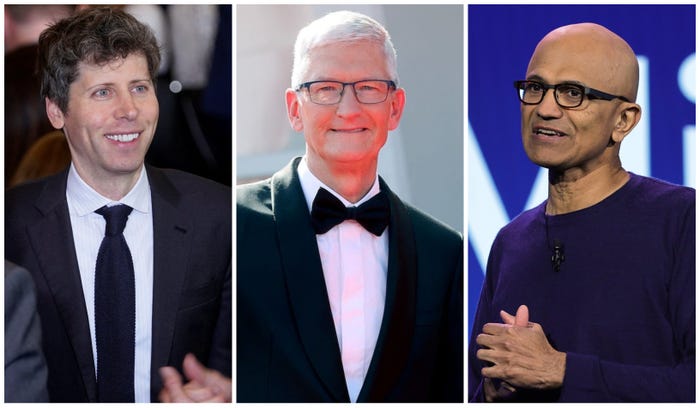
UPDATE: Top CEOs are rapidly integrating artificial intelligence (AI) into their daily routines, transforming how they manage tasks and communicate. From summarizing emails to conducting research, these business leaders are leveraging AI to enhance productivity and streamline operations in ways that could change the corporate landscape forever.
NEW REPORTS reveal that the global AI market is projected to surge to $4.8 trillion by 2033, indicating a significant shift in how businesses operate. Major figures like Microsoft’s Satya Nadella, OpenAI’s Sam Altman, and Apple’s Tim Cook are leading the charge in adopting AI technologies that promise to revolutionize their industries.
In a recent interview, Nadella explained how he uses Microsoft’s AI assistant, Copilot, during his daily routine. He uploads podcast transcripts to the app, allowing him to discuss insights with a voice assistant while commuting. Upon arriving at Microsoft’s headquarters in Redmond, Washington, he relies on Copilot to summarize messages from Outlook and Teams, declaring, “I’m an email typist,” highlighting the time-saving benefits of AI.
OpenAI’s Sam Altman has also embraced AI for personal tasks, stating, “Honestly, I use it in the boring ways.” After welcoming his first child in February, Altman said AI has been invaluable for parenting, helping him manage tasks and research developmental stages. “I don’t know how I would have done that,” he admitted, showcasing the profound impact AI can have on personal lives.
Nvidia’s Jensen Huang uses AI as a daily tutor, explaining his approach at the Milken Institute Global Conference in May. “I use it as a tutor every day,” he revealed, noting that AI helps him learn complex subjects. Huang emphasized how AI democratizes knowledge, making advanced programming accessible.
Apple’s Tim Cook is equally enthusiastic about AI’s potential. At the WWDC 2024, he introduced Apple Intelligence, stating it significantly aids in managing his emails. “If I can save time here and there, it adds up to something significant,” Cook said, underscoring the technology’s transformative effect on his workflow.
Real estate tech leader Jeremy Wacksman of Zillow is using AI to enhance efficiency. He shared that he utilizes ChatGPT to obtain personalized summaries of missed meetings, significantly reducing time spent on documentation. Wacksman encourages his team to explore AI, hosting “AI days” to celebrate innovations and implement AI tools in product development.
In the cryptocurrency space, Brian Armstrong of Coinbase reported a groundbreaking achievement: the first “AI to AI crypto transaction.” Armstrong stated that AI is not just a tool but a decision-maker in his company, pushing the boundaries of how businesses operate.
LinkedIn’s Ryan Roslansky described AI as “having a second brain,” particularly when drafting high-stakes emails to industry leaders. AI supports his writing process, ensuring he conveys professionalism and clarity in communication.
Finally, David Ricks, CEO of Eli Lilly, spoke about his company’s ambitious plans, including creating an AI-powered platform for biotech firms. Ricks revealed that AI assists him in meetings, enabling him to ask scientific questions in real-time, enhancing collaboration and innovation.
As AI reshapes corporate landscapes, the implications for productivity and efficiency are profound. These leaders are not just adopting AI; they are redefining what it means to work in the modern age.
WHAT TO WATCH: As AI technology continues to evolve, expect further announcements from these key industry players on their AI integration strategies. The way businesses operate could soon be transformed, making this a critical space to watch in the coming months.
Stay tuned for more updates on how AI is changing the dynamics of leadership and productivity across industries.

Cyber Monday 2025 Deals: Limited-Time Savings on Top Items!

SoftBank and Yaskawa Join Forces to Develop Advanced Office Robots

Analysts Set Price Target of $25.11 for Ingram Micro Shares

Winter Storm Hits Northern Pennsylvania; Drivers Urged to Stay Off Roads

Wall Street Analysts Adjust Ratings for Deere & Company Stock

Josh Brolin Reflects on Friendship with Donald Trump Before New Film

Dallas Pension Crisis Escalates as Board Rejects City’s Plan

Winter Weather Advisory Issued for South Central PA: Up to 3 Inches of Snow

ECB’s de Guindos Confirms Current Interest Rates Will Remain Steady

Inventor Achieves Breakthrough with 2 Billion FPS Laser Video

Community Unites for 7th Annual Into the Light Walk for Mental Health

Charlie Sheen’s New Romance: ‘Glowing’ with Younger Partner

Dua Lipa Aces GCSE Spanish, Sparks Super Bowl Buzz with Fans

Mother Fights to Reunite with Children After Kidnapping in New Drama

Former Mozilla CMO Launches AI-Driven Cannabis Cocktail Brand Fast

Tyler Technologies Set to Reveal Q3 Earnings on October 22

Curium Group, PeptiDream, and PDRadiopharma Launch Key Cancer Trial

Israel Reopens Rafah Crossing After Hostage Remains Returned
-
 Science1 month ago
Inventor Achieves Breakthrough with 2 Billion FPS Laser Video
-
 Health2 months ago
Community Unites for 7th Annual Into the Light Walk for Mental Health
-
 Top Stories2 months ago
Charlie Sheen’s New Romance: ‘Glowing’ with Younger Partner
-
 Entertainment2 months ago
Dua Lipa Aces GCSE Spanish, Sparks Super Bowl Buzz with Fans
-
 Entertainment2 months ago
Mother Fights to Reunite with Children After Kidnapping in New Drama
-
 Top Stories1 month ago
Former Mozilla CMO Launches AI-Driven Cannabis Cocktail Brand Fast
-
 Business2 months ago
Tyler Technologies Set to Reveal Q3 Earnings on October 22
-
 Health2 months ago
Curium Group, PeptiDream, and PDRadiopharma Launch Key Cancer Trial
-
 World2 months ago
Israel Reopens Rafah Crossing After Hostage Remains Returned
-

 World2 months ago
R&B Icon D’Angelo Dies at 51, Leaving Lasting Legacy
-

 Health2 months ago
North Carolina’s Biotech Boom: Billions in New Investments
-

 Entertainment2 months ago
Red Sox’s Bregman to Become Free Agent; Tigers Commit to Skubal