
Science
MD Anderson’s 77A Antibody Offers New Hope Against Cancers

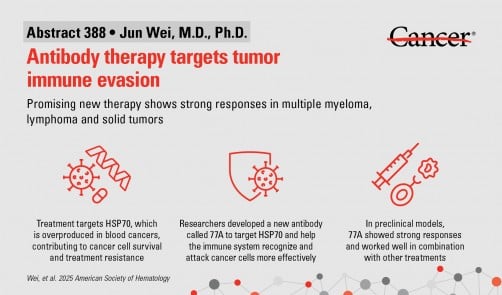
Researchers at The University of Texas MD Anderson Cancer Center have developed a promising new antibody therapy named 77A, which enhances immune responses against various blood cancers and solid tumors. In a preclinical study presented at the 67th American Society of Hematology (ASH) Annual Meeting on December 6, 2025, the therapy demonstrated its potential to overcome treatment resistance in conditions like myeloma and lymphoma, as well as in solid tumors.
Led by Jun Wei, M.D., Ph.D., an assistant professor in the department of Lymphoma & Myeloma, and principal investigator Robert Z. Orlowski, M.D., Ph.D., the study highlighted how 77A targets a specific cancer survival protein known as HSP70. This protein is often overproduced in cancer cells, allowing tumors to evade detection by the immune system and survive longer. By converting HSP70 into a trigger for the immune system, the antibody activates critical immune cells such as T cells and natural killer (NK) cells, reshaping the tumor environment to support enduring immune responses.
In laboratory models, 77A not only exhibited strong antitumor effects but also significantly enhanced the efficacy of existing treatments, including chemotherapy, radiation, and immunotherapies. Its ability to work synergistically with these therapies suggests that 77A could play a crucial role in future cancer treatment regimens.
Wei expressed optimism regarding the findings, stating, “There is tremendous promise in the way 77A is capable of rewiring the immune system, enabling it to respond effectively against multiple cancers. Our findings offer a new pathway to immunotherapy and patient treatment.”
Mechanism and Future Steps of 77A Therapy
The mechanism behind 77A’s effectiveness lies in its targeting of HSP70, a heat shock protein that often contributes to a hostile tumor environment by suppressing immune responses. By blocking the effects of HSP70, the antibody improves the ability of immune cells to identify and destroy cancer cells. Early tests with human immune cells also indicated that 77A could enhance immune responses in healthy donors, paving the way for potential clinical trials.
The research team is now focused on advancing a humanized version of 77A into clinical trials, aiming to evaluate its effectiveness across various cancer types. Orlowski remarked, “These results give us confidence that 77A could become a versatile immunotherapy. Our next step is to advance a humanized version of this antibody into clinical trials to evaluate its potential in patients across multiple cancer types.”
This study received support from Blood Cancer United, formerly known as the Leukemia & Lymphoma Society. As the research progresses, the potential for 77A to emerge as a significant therapeutic option for patients battling cancer becomes increasingly promising. The findings underscore the ongoing efforts to innovate cancer treatments and improve outcomes for individuals afflicted by these challenging diseases.

Urgent: Woman Killed in USPS Truck Collision in Des Plaines

Ocean City Council Approves $150 Million Hotel Amid Urgency

Piedmont Hills Falls 38-10 to Balboa in NorCal Championship

Urgent Alert: 6 PC Upgrade Mistakes That Can Ruin Performance

Conservatives Mock Pete Hegseth’s Trump-Reagan Comparison

Franchise Star Returns: Major Role in “Five Nights at Freddy’s” Sequel!

MD Anderson’s 77A Antibody Offers New Hope Against Cancers

Wyoming Defeats Dartmouth 93-80 in High-Scoring Basketball Clash

Hawaiian Airlines Unveils Fleet Changes Ahead of Alaska Merger

Inventor Achieves Breakthrough with 2 Billion FPS Laser Video

Community Unites for 7th Annual Into the Light Walk for Mental Health

Charlie Sheen’s New Romance: ‘Glowing’ with Younger Partner

Dua Lipa Aces GCSE Spanish, Sparks Super Bowl Buzz with Fans

Mother Fights to Reunite with Children After Kidnapping in New Drama

Curium Group, PeptiDream, and PDRadiopharma Launch Key Cancer Trial

Former Mozilla CMO Launches AI-Driven Cannabis Cocktail Brand Fast

Israel Reopens Rafah Crossing After Hostage Remains Returned

Tyler Technologies Set to Reveal Q3 Earnings on October 22
-
 Science2 months ago
Inventor Achieves Breakthrough with 2 Billion FPS Laser Video
-
 Health2 months ago
Community Unites for 7th Annual Into the Light Walk for Mental Health
-
 Top Stories2 months ago
Charlie Sheen’s New Romance: ‘Glowing’ with Younger Partner
-
 Entertainment2 months ago
Dua Lipa Aces GCSE Spanish, Sparks Super Bowl Buzz with Fans
-
 Entertainment2 months ago
Mother Fights to Reunite with Children After Kidnapping in New Drama
-
 Health2 months ago
Curium Group, PeptiDream, and PDRadiopharma Launch Key Cancer Trial
-
 Top Stories2 months ago
Former Mozilla CMO Launches AI-Driven Cannabis Cocktail Brand Fast
-
 World2 months ago
Israel Reopens Rafah Crossing After Hostage Remains Returned
-
 Business2 months ago
Tyler Technologies Set to Reveal Q3 Earnings on October 22
-

 World2 months ago
R&B Icon D’Angelo Dies at 51, Leaving Lasting Legacy
-

 Health2 months ago
North Carolina’s Biotech Boom: Billions in New Investments
-

 Entertainment2 months ago
Red Sox’s Bregman to Become Free Agent; Tigers Commit to Skubal