
Science
Researchers Unearth Ancient Roman Stairway, Revealing “Lost Pompeii”

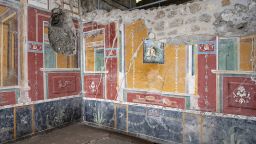
Researchers have made significant strides in uncovering the mysteries of ancient Pompeii, revealing an architectural treasure: a monumental stairway within the Casa del Tiaso, or House of the Thiasos. This discovery, part of the ongoing efforts to digitally reconstruct the lost city, offers new insights into the lives and structures that once stood before the catastrophic eruption of Mount Vesuvius in AD 79.
The eruption entombed Pompeii under layers of ash and debris, preserving its buildings and artifacts for nearly two millennia. Many residents perished, while others fled, leaving the city frozen in time. Excavations have been ongoing since 1748, revealing a wealth of historical artifacts, including frescoes and remnants of daily life. Yet, significant gaps in knowledge about the city’s architecture persisted, particularly concerning upper floors and their uses.
To bridge these gaps, researchers have embraced a combination of advanced technology and traditional archaeological methods. The team, led by Dr. Susanne Muth from Humboldt University, is employing digital archaeology techniques, including LiDAR scans and close-range photography, to document and reconstruct Pompeii’s lost structures. These innovative approaches allow them to visualize elements of the city that were previously obscured by volcanic material.
Unveiling the Architectural Past
During a visit to Pompeii in 2022, Muth was inspired by the ongoing preservation efforts. She proposed the use of non-invasive digital reconstruction to enhance understanding of the site. This initiative captured the attention of the Archaeological Park of Pompeii, which partnered with her university to pursue this ambitious project.
The team’s methodologies involve creating 3D models based on clues found during scans, which include indentations indicating where structures may have once existed. By reconstructing these elements, they aim to gain a clearer picture of life in Pompeii before the eruption. Muth noted, “By reconstructing the lost architecture, we gain a more nuanced and historically accurate understanding of the ancient city and life within it.”
Recent findings indicate that inhabitants returned to Pompeii shortly after the eruption, rebuilding and adapting their lives in the shadow of destruction. Gabriel Zuchtriegel, director of the archaeological park, explained, “The volcanic debris and ash covering Pompeii after the eruption reached approximately five meters height,” or 16 feet, allowing some structures to remain partially visible.
The Casa del Tiaso Discovery
One of the key discoveries has been the Casa del Tiaso, an opulent residence likely belonging to a wealthy family. The house features large banquet rooms and private thermal baths, indicative of the status of its inhabitants. The recently uncovered monumental staircase suggests the existence of a tower, a rarity for urban homes in Pompeii.
Muth elaborated on the significance of the staircase: “When we began to reconstruct this room in terms of its lost architecture, it became clear to us that it could only be a tower.” This architectural feature aligns with descriptions from ancient texts, where towers in luxurious villas were used for social gatherings and observation.
Historically, the absence of such towers in urban settings has puzzled archaeologists. Muth explained that previous excavations prioritized finding precious artifacts, neglecting the potential significance of upper floors. The renewed focus on these areas has revealed that even wealthier citizens utilized upper rooms, contradicting earlier assumptions about their use.
The evidence from the Casa del Tiaso suggests a sophisticated approach to urban architecture, where the residents sought to replicate the grandeur of country villas within the city. This finding may reshape perceptions of Pompeii’s skyline and its architectural diversity.
The research team continues to investigate whether other urban homes contained similar features. As they delve deeper into Pompeii’s history, they are also exploring the potential for digital tools to preserve and monitor the site’s conservation status.
Muth emphasized the role of digital archaeology as more than mere reconstruction: “It’s a way of thinking through these structures and how they really worked and were used.” This focus on integrating technology with archaeology not only enhances the understanding of ancient life but also supports the preservation of Pompeii for future generations.
In total, more than 13,000 rooms have been excavated since 1748, with a significant portion of Pompeii still buried beneath volcanic ash. The ongoing research aims to uncover these hidden stories while ensuring that the cultural heritage of this extraordinary site is safeguarded for years to come.

Top Cannabis Products to Enhance Your Holiday Gatherings NOW

Clackamas County Deputies Shoot Man Wielding Axe, Identified

Luke Combs Unveils ‘My Kinda Saturday Night’ World Tour for 2026

Avrupa Minerals Shares Surge 25% – Is It Time to Invest?

New York Launches “Don’t Be Salty” Campaign to Curb Road Salt Use

Bonds and Clemens Denied Hall of Fame Again, Future in Jeopardy

Trump and Xi Strike Urgent Deal for Nvidia to Export AI Chips

Historic DL&W Terminal Opens Today, Buffalo Seeks New Retail Tenants

CAMCO Honors Bainbridge, Little & Co. as 2025 Vendor of the Year

Inventor Achieves Breakthrough with 2 Billion FPS Laser Video

Community Unites for 7th Annual Into the Light Walk for Mental Health

Charlie Sheen’s New Romance: ‘Glowing’ with Younger Partner

Dua Lipa Aces GCSE Spanish, Sparks Super Bowl Buzz with Fans

Curium Group, PeptiDream, and PDRadiopharma Launch Key Cancer Trial

Former Mozilla CMO Launches AI-Driven Cannabis Cocktail Brand Fast

Mother Fights to Reunite with Children After Kidnapping in New Drama

Israel Reopens Rafah Crossing After Hostage Remains Returned

Tyler Technologies Set to Reveal Q3 Earnings on October 22
-
 Science2 months ago
Inventor Achieves Breakthrough with 2 Billion FPS Laser Video
-
 Health2 months ago
Community Unites for 7th Annual Into the Light Walk for Mental Health
-
 Top Stories2 months ago
Charlie Sheen’s New Romance: ‘Glowing’ with Younger Partner
-
 Entertainment2 months ago
Dua Lipa Aces GCSE Spanish, Sparks Super Bowl Buzz with Fans
-
 Health2 months ago
Curium Group, PeptiDream, and PDRadiopharma Launch Key Cancer Trial
-
 Top Stories2 months ago
Former Mozilla CMO Launches AI-Driven Cannabis Cocktail Brand Fast
-
 Entertainment2 months ago
Mother Fights to Reunite with Children After Kidnapping in New Drama
-
 World2 months ago
Israel Reopens Rafah Crossing After Hostage Remains Returned
-
 Business2 months ago
Tyler Technologies Set to Reveal Q3 Earnings on October 22
-

 World2 months ago
R&B Icon D’Angelo Dies at 51, Leaving Lasting Legacy
-

 Health2 months ago
North Carolina’s Biotech Boom: Billions in New Investments
-

 Health2 months ago
YouTube Launches New Mental Health Tools for Teen Users