
Top Stories
Cashless Payments Surge, Leaving Vulnerable New Yorkers Stranded

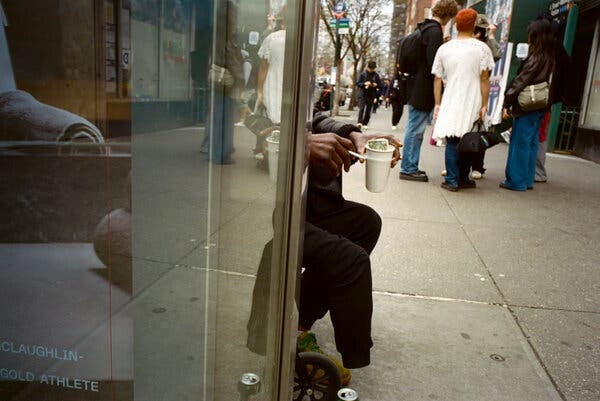
UPDATE: A growing reliance on cashless payments in New York is leaving vulnerable populations struggling to survive. With the rise of tap-to-pay services and digital payment apps, many affluent New Yorkers are moving away from cash, creating an urgent crisis for those who depend on it.
According to a 2022 Pew survey, approximately 60 percent of adults with household incomes above $100,000 report making no cash purchases in a typical week. In stark contrast, only 24 percent of individuals earning less than $30,000 can say the same. This disparity highlights a troubling trend as cashless transactions become the norm.
In the heart of New York City, the impact of this shift is palpable. Street performers, food vendors, and those in desperate need, such as the homeless, are feeling the pinch as fewer people carry cash. One affected individual, Rob Brender, has been panhandling for nearly a decade. “I can’t deal with rejection,” the 55-year-old said from his usual spot near busy stores. Instead of asking passersby for change, he relies on simply sitting with a cup, listening to music, and hoping for generosity.
However, Brender’s earnings have dwindled recently. Despite the bustling crowds, he notes that cash isn’t flowing into his cup as it used to. Living in a group home at Creedmoor Psychiatric Center, he recently received a sign from a friend displaying his Venmo username. Unfortunately, no one has used it, and he admits he doesn’t even know how to access the funds.
This shift towards a cashless society raises critical questions about financial inclusivity. As more affluent consumers adopt digital payment methods, the less fortunate are left behind, unable to adapt to a landscape where cash is increasingly obsolete.
Officials and advocates are calling for immediate action to address this growing divide. The reliance on cashless payments must be balanced with the realities faced by those in lower income brackets who depend on physical currency. As New York City continues to embrace technological advancements, the urgency to create solutions for those left behind cannot be overstated.
What happens next is crucial. Authorities may need to consider policies that ensure vulnerable populations are not excluded from the economy, including support for digital literacy and accessible payment options.
As this situation develops, the need for empathy and action is more pressing than ever. The voices of those affected, like Rob Brender, must be heard as the city navigates the future of transactions. In a society that increasingly values speed and convenience, we cannot forget those who need cash to survive.

Cyber Monday Deals Under $25: Shop Must-Have Gifts NOW

Federal Appeals Court Disqualifies Alina Habba as U.S. Attorney

Upgrade Your Home Lab NOW: All-SSD NAS Revolutionizes Storage

Carolina Herrera Unveils Vibrant Resort 2026 Collection in New York

Bra Fitting in Melbourne Sparks Reflections on Connection

Celebrities Showcase Cartier’s Panthère: A Timeless Fashion Icon

Virtus Advisers Acquires Boston Scientific Shares Worth $157,000

Octave Bioscience Partners with Quest Diagnostics to Enhance MS Testing Access

Sepio Capital Reduces Stake in Costco by 6.8% Amid Investor Activity

Inventor Achieves Breakthrough with 2 Billion FPS Laser Video

Community Unites for 7th Annual Into the Light Walk for Mental Health

Charlie Sheen’s New Romance: ‘Glowing’ with Younger Partner

Dua Lipa Aces GCSE Spanish, Sparks Super Bowl Buzz with Fans

Mother Fights to Reunite with Children After Kidnapping in New Drama

Former Mozilla CMO Launches AI-Driven Cannabis Cocktail Brand Fast

Tyler Technologies Set to Reveal Q3 Earnings on October 22

Curium Group, PeptiDream, and PDRadiopharma Launch Key Cancer Trial

Israel Reopens Rafah Crossing After Hostage Remains Returned
-
 Science1 month ago
Inventor Achieves Breakthrough with 2 Billion FPS Laser Video
-
 Health2 months ago
Community Unites for 7th Annual Into the Light Walk for Mental Health
-
 Top Stories2 months ago
Charlie Sheen’s New Romance: ‘Glowing’ with Younger Partner
-
 Entertainment2 months ago
Dua Lipa Aces GCSE Spanish, Sparks Super Bowl Buzz with Fans
-
 Entertainment2 months ago
Mother Fights to Reunite with Children After Kidnapping in New Drama
-
 Top Stories2 months ago
Former Mozilla CMO Launches AI-Driven Cannabis Cocktail Brand Fast
-
 Business2 months ago
Tyler Technologies Set to Reveal Q3 Earnings on October 22
-
 Health2 months ago
Curium Group, PeptiDream, and PDRadiopharma Launch Key Cancer Trial
-
 World2 months ago
Israel Reopens Rafah Crossing After Hostage Remains Returned
-

 World2 months ago
R&B Icon D’Angelo Dies at 51, Leaving Lasting Legacy
-

 Entertainment2 months ago
Red Sox’s Bregman to Become Free Agent; Tigers Commit to Skubal
-

 Health2 months ago
North Carolina’s Biotech Boom: Billions in New Investments