
Science
Charles Darwin’s Address Book Reveals New Insights into His Life

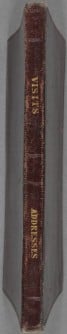
The National University of Singapore (NUS) has unveiled Charles Darwin’s personal Address Book, providing an unprecedented glimpse into the life and work of the renowned scientist. Published for the first time on October 3, 2023, this small leather notebook, spanning just 48 pages yet containing approximately 500 entries, was initiated by Darwin’s wife, Emma Darwin, shortly after their marriage in January 1839.
Darwin continued to add to the Address Book after moving his family to Down in 1842, using it throughout his lifetime. The NUS project not only features scans of the notebook but also includes expertly transcribed and edited entries, along with hundreds of editorial notes that clarify the identities of the abbreviated contacts. These notes further link to Darwin’s extensive correspondence and published works, a valuable addition to the vast literature surrounding his life.
New Discoveries in Darwin’s Social Network
This Address Book reveals a network that extends beyond the known correspondence documented in the 30 volumes produced by the 50-year-long Darwin correspondence project. While it is well-documented that Darwin corresponded through around 15,000 letters, the Address Book brings to light numerous names, businesses, and references that have not been previously recognized.
Among its entries are unique references to articles in the Gardeners’ Chronicle, which Darwin utilized for research, as well as various recipes and notes related to his estate, such as rat poison formulations and methods for cleaning animal skeletons. Other intriguing entries include reminders for purchasing a lawn mower, weighing scales, and even a fireworks display for his village. This assortment illustrates Darwin’s multifaceted interests and responsibilities.
The notebook also documents contacts with pigeon breeders, tradesmen, and notable figures including the father of Oscar Wilde and social reformer Octavia Hill. One significant late entry features an optician, Dixey & Son, who supplied eyewear to Queen Victoria and later, Winston Churchill. The firm, still operational today, had no prior knowledge of Darwin as a client due to their records being destroyed during World War II.
Historical Context and Significance
Another remarkable aspect of the Address Book is a reference to Alfred Russel Wallace, who independently developed a theory of evolution by natural selection. The notebook contains the address of Wallace’s shipping agent in Singapore, which served as his base during his eight years of research in Southeast Asia. Such connections emphasize the collaborative nature of scientific discovery during that era.
Historian of science Dr. John van Wyhe, from the NUS Faculty of Science, expressed the significance of this finding, stating, “It’s incredible that this little treasure-trove of details by Darwin has remained unpublished until now. It offers fascinating new insights into his life and the way he worked.”
The Address Book has significant historical value, not just for its contents but also as a social document that reflects the personal and professional interactions of one of history’s greatest scientists. It remained within Darwin’s family after his death and was eventually transferred to Cambridge University Library in 1942, before being moved to Down House, his former home, in 1948.
The full Address Book is now accessible online through the Darwin Online project, which has been dedicated to transcribing and editing the entirety of the Darwin Archive since 2005. This initiative has garnered international acclaim, culminating in the launch of Darwin’s complete library online in 2024.
By shedding light on previously unknown aspects of Darwin’s life, this publication offers a richer understanding of the man behind the revolutionary theories on evolution that have shaped scientific thought to this day.
For further exploration, the Address Book can be viewed at: Darwin Online.

Sister Steps In to Buy Brother’s House Amid Financial Crisis

Urgent: Santa Claus Arrested for Alleged Child Abuse in Brazil

Boulder Faces Crisis: Rising Costs and Controversial Honors Spark Outrage

Wolves Attack: Nine Killed in Recent Spate of Incidents in India

Quadrature Capital Reduces Merck Holdings by 87.8% Amid Market Shifts

Discover the Top 5 Must-Watch Netflix Shows from December 1–7, 2025

Research Reveals Early Movements May Alleviate Back Pain

Community Mourns the Passing of Susan Kay Duncan, 74

Fisher Asset Management Boosts Alibaba Stake by 390,883 Shares

Inventor Achieves Breakthrough with 2 Billion FPS Laser Video

Community Unites for 7th Annual Into the Light Walk for Mental Health

Charlie Sheen’s New Romance: ‘Glowing’ with Younger Partner

Dua Lipa Aces GCSE Spanish, Sparks Super Bowl Buzz with Fans

Mother Fights to Reunite with Children After Kidnapping in New Drama

Former Mozilla CMO Launches AI-Driven Cannabis Cocktail Brand Fast

Curium Group, PeptiDream, and PDRadiopharma Launch Key Cancer Trial

Tyler Technologies Set to Reveal Q3 Earnings on October 22

Israel Reopens Rafah Crossing After Hostage Remains Returned
-
 Science1 month ago
Inventor Achieves Breakthrough with 2 Billion FPS Laser Video
-
 Health2 months ago
Community Unites for 7th Annual Into the Light Walk for Mental Health
-
 Top Stories2 months ago
Charlie Sheen’s New Romance: ‘Glowing’ with Younger Partner
-
 Entertainment2 months ago
Dua Lipa Aces GCSE Spanish, Sparks Super Bowl Buzz with Fans
-
 Entertainment2 months ago
Mother Fights to Reunite with Children After Kidnapping in New Drama
-
 Top Stories1 month ago
Former Mozilla CMO Launches AI-Driven Cannabis Cocktail Brand Fast
-
 Health2 months ago
Curium Group, PeptiDream, and PDRadiopharma Launch Key Cancer Trial
-
 Business2 months ago
Tyler Technologies Set to Reveal Q3 Earnings on October 22
-
 World2 months ago
Israel Reopens Rafah Crossing After Hostage Remains Returned
-

 World2 months ago
R&B Icon D’Angelo Dies at 51, Leaving Lasting Legacy
-

 Health2 months ago
North Carolina’s Biotech Boom: Billions in New Investments
-
 Entertainment2 months ago
Red Sox’s Bregman to Become Free Agent; Tigers Commit to Skubal