
Science
Metal Detectorist Uncovers Remarkable Viking Age Grave in Norway

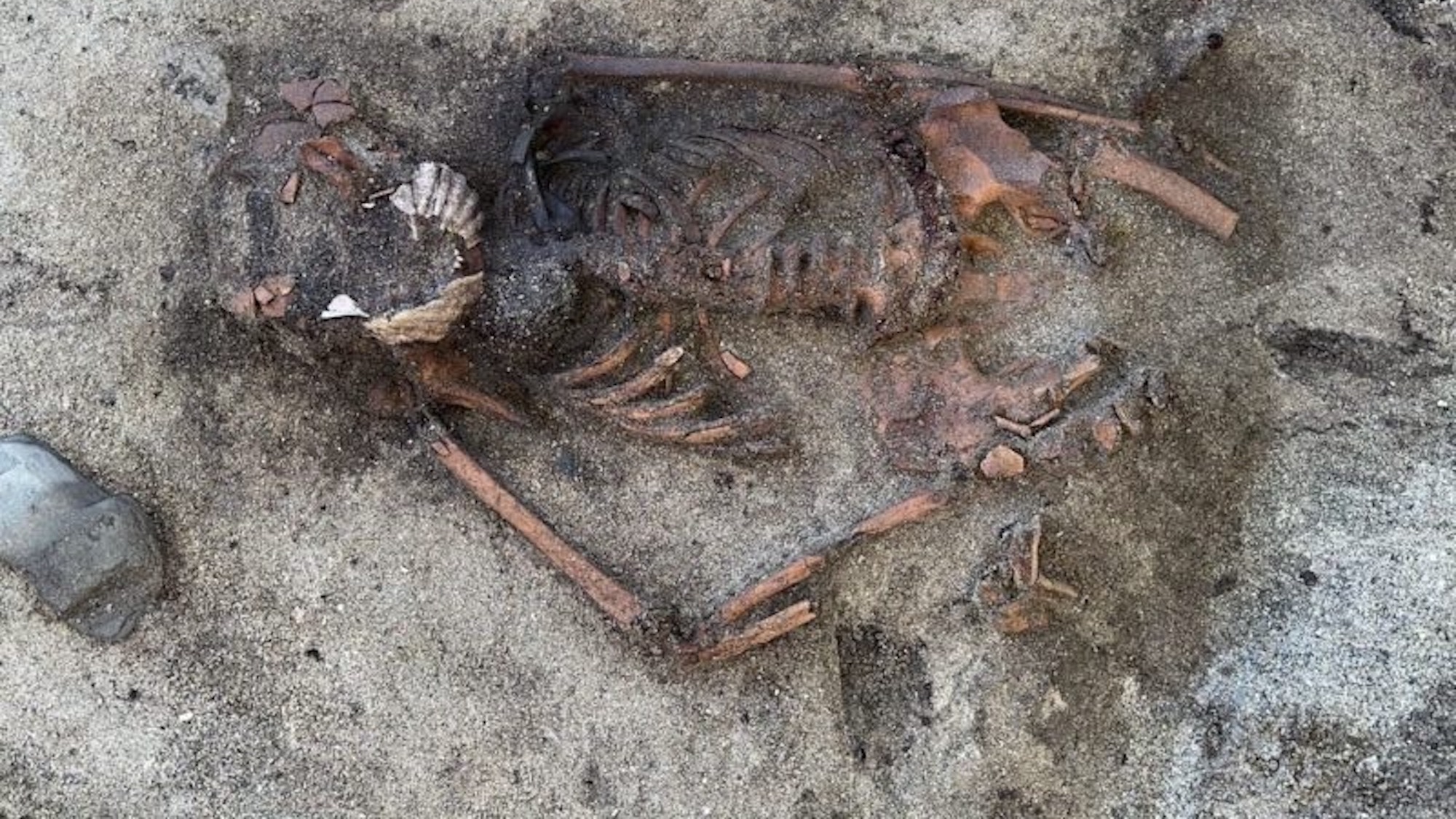
A significant archaeological discovery has emerged in Trøndelag County, Norway, where a metal detectorist stumbled upon a Viking Age grave containing elaborate burial artifacts. The grave, believed to belong to a woman, showcases a striking collection of jewelry and costume elements from the 800s, as reported by Norwegian SciTech News, a publication affiliated with the Norwegian University of Science and Technology and the research organization SINTEF.
Roy Søreng, the metal detectorist who made the initial find, unearthed an oval brooch and promptly contacted researchers to investigate further. In response, a team of archaeologists began excavating the site discreetly to safeguard its historical significance.
Grave Artifacts Reveal Insights into Viking Life
According to Raymond Sauvage, head engineer at the NTNU Museum’s Department of Archaeology and Cultural History, the grave contains remains believed to belong to a free woman, likely married and possibly a landowner. “This indicates that she was a free and probably married woman, perhaps the mistress of the farm,” Sauvage stated. The excavation revealed skeletal remains alongside two oval brooches, one of which was discovered by Søreng, and a ring buckle that would have been used to fasten a petticoat.
One of the most intriguing aspects of this burial is the presence of two scallop shells that partially covered the deceased’s mouth. In medieval times, scallop shells symbolized the cult of St. James, yet their occurrence in pre-Christian graves is exceedingly rare. “This is a practice that is not previously known from pre-Christian graves in Norway. We don’t yet know what the symbolism means,” Sauvage elaborated.
Alongside the shells, archaeologists also found bird bones, which are likely wing bones, suggesting a deeper symbolic significance to the burial rites. The excavation follows an earlier discovery in the same area, where a well-preserved skeleton was recovered earlier this year.
Preserving History and Conducting Analysis
Hanne Bryn, field supervisor at the NTNU Museum, noted that the newly discovered grave is likely one to three generations younger than the earlier skeleton. “During the inspection, we quickly realized that we were facing a new skeletal grave that was in acute danger of being damaged during the next ploughing,” Bryn explained. The prompt actions of landowner Arve Innstrand allowed the excavation to proceed without delay.
As the excavation concludes, the focus will shift to analysis. “We will examine the skeleton, preserve the objects and take samples for dating and DNA analysis. The goal is to learn more about the person and about possible kinship to the previous find from the same place,” Sauvage noted. Researchers will investigate details such as body height, gender-defining traits, and any signs of disease.
This discovery not only enriches our understanding of Viking burial practices but also highlights the importance of metal detectorists in uncovering significant historical artifacts. As the analysis progresses, the findings may provide further insights into the lives of individuals during the Viking Age, shedding light on societal structures and cultural practices of the time.

Multiple Victims Reported in Brown University Shooting Incident

U.S. Housing Market: Vacancy Rates Show Mixed Signals for Renters

Discover 10 Classic Horror Films That Define the Genre

Peter Greene Passes Away at 60: Manager Shares Final Conversation

Paris Hilton Showcases Stylish Chanel Boots at T-Mobile Launch

Former DOJ Lawyers Resign Over Controversial UC Antisemitism Probes

Colorado Buffs Surge in Second Half, Defeat UTSA 88-64

Urgent: Multiple Victims in Brown University Shooting Incident

Army-Navy Game Unites Fans to Honor Veterans and Community

Inventor Achieves Breakthrough with 2 Billion FPS Laser Video

Charlie Sheen’s New Romance: ‘Glowing’ with Younger Partner

Community Unites for 7th Annual Into the Light Walk for Mental Health

Dua Lipa Aces GCSE Spanish, Sparks Super Bowl Buzz with Fans

Curium Group, PeptiDream, and PDRadiopharma Launch Key Cancer Trial

Former Mozilla CMO Launches AI-Driven Cannabis Cocktail Brand Fast

Israel Reopens Rafah Crossing After Hostage Remains Returned

Mother Fights to Reunite with Children After Kidnapping in New Drama

R&B Icon D’Angelo Dies at 51, Leaving Lasting Legacy
-
 Science2 months ago
Inventor Achieves Breakthrough with 2 Billion FPS Laser Video
-
 Top Stories2 months ago
Charlie Sheen’s New Romance: ‘Glowing’ with Younger Partner
-
 Health2 months ago
Community Unites for 7th Annual Into the Light Walk for Mental Health
-
 Entertainment2 months ago
Dua Lipa Aces GCSE Spanish, Sparks Super Bowl Buzz with Fans
-
 Health2 months ago
Curium Group, PeptiDream, and PDRadiopharma Launch Key Cancer Trial
-
 Top Stories2 months ago
Former Mozilla CMO Launches AI-Driven Cannabis Cocktail Brand Fast
-
 World2 months ago
Israel Reopens Rafah Crossing After Hostage Remains Returned
-
 Entertainment2 months ago
Mother Fights to Reunite with Children After Kidnapping in New Drama
-
 World2 months ago
R&B Icon D’Angelo Dies at 51, Leaving Lasting Legacy
-

 Business2 months ago
Tyler Technologies Set to Reveal Q3 Earnings on October 22
-

 Health2 months ago
North Carolina’s Biotech Boom: Billions in New Investments
-

 Health2 months ago
YouTube Launches New Mental Health Tools for Teen Users