
Science
Researchers Launch $1.25M Project for Real-Time Hazard Monitoring in Hawaiʻi

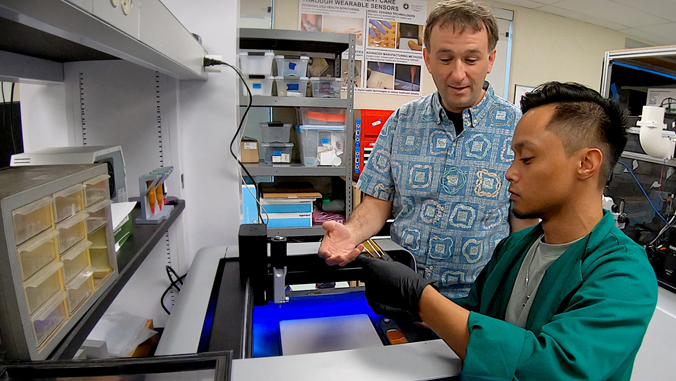
In a significant step towards enhancing disaster preparedness in Hawaiʻi, researchers from the University of Hawaiʻi at Mānoa and Georgia Tech have secured a $1.25 million grant from the National Science Foundation. This funding aims to develop innovative sensors that can provide real-time data on various environmental hazards, including wildfires, droughts, floods, hurricanes, and water contamination.
The project focuses on creating low-cost, locally made sensors that can be produced quickly and deployed on the same day. These sensors will be capable of measuring critical factors such as water quality and soil contamination. The data collected will be transmitted via an AI-enabled handheld device, which is smaller than a cell phone, allowing users to access and interpret the information through a publicly available dashboard.
Community-Centric Design Approach
A core aspect of this initiative is its commitment to co-designing technology with local communities. The project will involve stakeholders who have responsibility for land and water stewardship in Hawaiʻi, including land management organizations, Hawaiian-language immersion schools, and community colleges. This collaborative effort will ensure that the technology addresses local needs and priorities.
Tyler Ray, the principal investigator and an associate professor at the UH Mānoa College of Engineering, emphasized the importance of local input: “We can shorten the path from idea to instrument and build sensors tuned to local priorities without relying on centralized, hard-to-access facilities.” The aim is to create a robust and affordable design-to-deployment process that is replicable across the islands.
The sensors will be paired with a small, durable edge device capable of harvesting and storing energy. This device will run machine learning models and function effectively even in areas with limited network connectivity. An open library of circuits and firmware will allow partners to customize sensors for various measurements, including pH levels, turbidity, and the presence of heavy metals.
Building Strong Community Relationships
The project builds upon existing relationships across the islands of Oʻahu, Maui, and Kauaʻi. By involving residents, educators, and resource stewards, the team aims to align the technology with community priorities. Iterative design workshops and peer exchanges will facilitate collaboration, culminating in a capstone gathering to share findings and designs.
Josiah Hester, a Kanaka ʻŌiwi and associate professor at Georgia Tech, highlighted the significance of this initiative: “Deploying AI devices in austere environments, making AI interpretable and understandable, and providing these capabilities to everyone are key goals we will achieve.” Hester, who identifies as a Native Hawaiian scientist, expressed his commitment to translating these technologies to support community stewardship.
The project will also emphasize data governance, ensuring local control and appropriate confidentiality for sensitive information. As Aurora Kagawa-Viviani, co-principal investigator and assistant professor at the UH Mānoa’s Water Resources Research Center, noted, “Building strong and equitable relationships ensures the technology and the data it produces have lasting value long after the prototype.”
In addition to developing technology, the grant will support hands-on training for students across K–12, community colleges, and research universities. The team plans to release open hardware, software, and design artifacts, allowing others to adapt these resources for island, rural, and urban settings facing similar hazards.
This project represents a proactive approach to environmental safety in Hawaiʻi, blending advanced technology with community knowledge to create effective solutions for local challenges.

Macron Warns of Tariffs on China in Urgent Trade Stand-off

AM4 Gaming Combos Break Through 2026 Hardware Barriers Now

Walmart Slashes Price on 32-Piece Cookware Set to $79 NOW!

Kremlin Praises Trump’s “Strong” Strategy Amid Ukraine Talks

Create Gourmet Meals at Home with Affordable Pantry Staples

EUR/USD Holds Steady at 1.1650 Amid US Data and ECB Concerns

Six Spicy Book Adaptations Set to Heat Up Your Screens

Virtual Program Targets Lymphoma Treatment Side Effects

Jabari Walker Embraces Veteran Influence with Sixers

Inventor Achieves Breakthrough with 2 Billion FPS Laser Video

Community Unites for 7th Annual Into the Light Walk for Mental Health

Charlie Sheen’s New Romance: ‘Glowing’ with Younger Partner

Dua Lipa Aces GCSE Spanish, Sparks Super Bowl Buzz with Fans

Curium Group, PeptiDream, and PDRadiopharma Launch Key Cancer Trial

Former Mozilla CMO Launches AI-Driven Cannabis Cocktail Brand Fast

Mother Fights to Reunite with Children After Kidnapping in New Drama

Israel Reopens Rafah Crossing After Hostage Remains Returned

Tyler Technologies Set to Reveal Q3 Earnings on October 22
-
 Science2 months ago
Inventor Achieves Breakthrough with 2 Billion FPS Laser Video
-
 Health2 months ago
Community Unites for 7th Annual Into the Light Walk for Mental Health
-
 Top Stories2 months ago
Charlie Sheen’s New Romance: ‘Glowing’ with Younger Partner
-
 Entertainment2 months ago
Dua Lipa Aces GCSE Spanish, Sparks Super Bowl Buzz with Fans
-
 Health2 months ago
Curium Group, PeptiDream, and PDRadiopharma Launch Key Cancer Trial
-
 Top Stories2 months ago
Former Mozilla CMO Launches AI-Driven Cannabis Cocktail Brand Fast
-
 Entertainment2 months ago
Mother Fights to Reunite with Children After Kidnapping in New Drama
-
 World2 months ago
Israel Reopens Rafah Crossing After Hostage Remains Returned
-
 Business2 months ago
Tyler Technologies Set to Reveal Q3 Earnings on October 22
-

 World2 months ago
R&B Icon D’Angelo Dies at 51, Leaving Lasting Legacy
-
 Health2 months ago
North Carolina’s Biotech Boom: Billions in New Investments
-

 Entertainment2 months ago
Red Sox’s Bregman to Become Free Agent; Tigers Commit to Skubal