
Science
Scientists Unveil ‘OCTOID,’ a Color-Changing Soft Robot

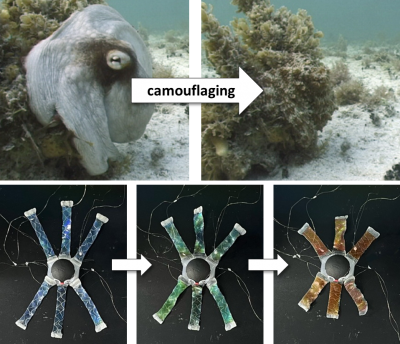
A research team led by Dr. Dae-Yoon Kim at the Korea Institute of Science and Technology (KIST) has introduced a groundbreaking soft robot named ‘OCTOID’. This innovative creation is designed to mimic the remarkable camouflage and locomotion abilities of octopuses, allowing it to change both color and shape in response to its environment.
OCTOID represents a significant advancement in the field of robotics, as it integrates multiple functionalities. Unlike traditional soft robots that primarily bend or stretch, this new device dynamically alters its color according to electrical stimulation. It can also adapt its movement to blend seamlessly with its surroundings and has the capability to grasp objects effectively.
Innovative Design and Technology
The development of OCTOID showcases the potential for soft robotics to revolutionize various sectors, including healthcare, manufacturing, and environmental monitoring. The robot’s design leverages advanced materials and engineering techniques, enabling it to perform complex tasks that require both agility and sensitivity.
OCTOID’s ability to change color holds promise for applications in areas such as search and rescue operations, where it can camouflage itself in diverse environments. Additionally, its capacity to manipulate objects could enhance the functionality of robotic systems in delicate or hazardous settings.
According to KIST President Sangrok Oh, the research focuses on creating robots that not only perform tasks but also interact more naturally with human users and their surroundings. The versatility of OCTOID opens up new avenues for research and development in robotics, emphasizing the importance of biomimicry in engineering.
Implications for Future Research
As the field of soft robotics continues to expand, OCTOID can serve as a foundational model for future innovations. The research team at KIST is exploring the potential for more complex color-changing mechanisms and enhanced movement capabilities.
The implications of such technology extend beyond robotics; they may also influence materials science and wearable technology. By understanding how natural organisms like octopuses adapt to their environments, researchers can create more efficient and responsive robotic systems.
This development not only highlights the cutting-edge research being conducted at KIST but also underscores the growing intersection of biology and technology, paving the way for a new era in robotics. As the team moves forward with further studies, the global community watches closely for the next steps in this exciting area of research.

Former Russian General Slams Intelligence, Issues Failing Grade

Urgent: Social Media Friendship Confusion Sparks Emotional Debate

Honolulu Honors Spencer Allen and Alakai Hudgens for Heroic Rescue

Trump Reports Positive Meeting Between Kushner, Witkoff and Putin

Scientists Unveil ‘OCTOID,’ a Color-Changing Soft Robot

Washington Dominates San Jose with 7-1 Victory in NHL Match

Delta Air Lines Projects $200 Million Loss Due to Shutdown

Solana Blockchain Fuels Growth as Kalshi Launches New Contracts

Min Hee Jin Addresses Ongoing Lawsuits with HYBE in Urgent Broadcast

Inventor Achieves Breakthrough with 2 Billion FPS Laser Video

Community Unites for 7th Annual Into the Light Walk for Mental Health

Charlie Sheen’s New Romance: ‘Glowing’ with Younger Partner

Dua Lipa Aces GCSE Spanish, Sparks Super Bowl Buzz with Fans

Curium Group, PeptiDream, and PDRadiopharma Launch Key Cancer Trial

Mother Fights to Reunite with Children After Kidnapping in New Drama

Israel Reopens Rafah Crossing After Hostage Remains Returned

Tyler Technologies Set to Reveal Q3 Earnings on October 22

Former Mozilla CMO Launches AI-Driven Cannabis Cocktail Brand Fast
-
 Science2 months ago
Inventor Achieves Breakthrough with 2 Billion FPS Laser Video
-
 Health2 months ago
Community Unites for 7th Annual Into the Light Walk for Mental Health
-
 Top Stories2 months ago
Charlie Sheen’s New Romance: ‘Glowing’ with Younger Partner
-
 Entertainment2 months ago
Dua Lipa Aces GCSE Spanish, Sparks Super Bowl Buzz with Fans
-
 Health2 months ago
Curium Group, PeptiDream, and PDRadiopharma Launch Key Cancer Trial
-
 Entertainment2 months ago
Mother Fights to Reunite with Children After Kidnapping in New Drama
-
 World2 months ago
Israel Reopens Rafah Crossing After Hostage Remains Returned
-
 Business2 months ago
Tyler Technologies Set to Reveal Q3 Earnings on October 22
-
 Top Stories2 months ago
Former Mozilla CMO Launches AI-Driven Cannabis Cocktail Brand Fast
-

 Health2 months ago
North Carolina’s Biotech Boom: Billions in New Investments
-

 World2 months ago
R&B Icon D’Angelo Dies at 51, Leaving Lasting Legacy
-

 Entertainment2 months ago
Red Sox’s Bregman to Become Free Agent; Tigers Commit to Skubal