
World
Trump Signals U.S. Support for Argentina Depends on Election Outcome

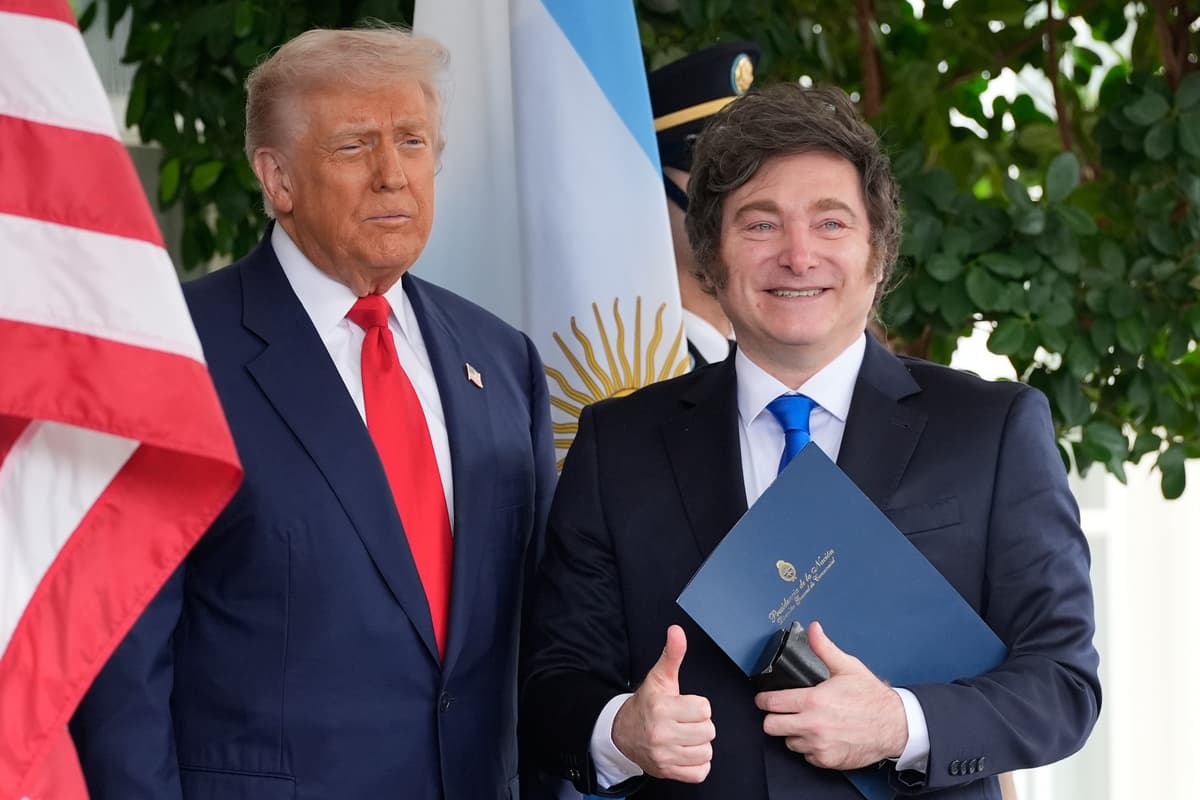
President Donald Trump has stated that the United States will not invest time or resources in Argentina if current President Javier Milei loses the upcoming midterm elections. This remark came during Milei’s visit to the White House, where he secured a significant $20 billion currency swap aimed at alleviating Argentina’s financial crisis.
During their meeting, Trump expressed optimism about Milei’s prospects in the elections for Argentina’s legislative body set for later this month. He remarked on Milei’s polling numbers, suggesting they were “pretty good,” and predicted improvement following the announcement of the financial deal. “Our approvals are somewhat subject to who wins the election,” Trump noted, highlighting a possible shift in U.S. policy based on the electoral outcome.
Trump’s comments extended to the potential opponent Milei may face, whom he described as “extremely far left.” He attributed Argentina’s current difficulties to the opposing philosophy, asserting that U.S. support would diminish if Milei were to lose. “If he loses, we are not going to be generous with Argentina,” Trump added, emphasizing his belief in Milei’s victory. “If he does win, we’re going to be very helpful.”
The deal, which many view as a form of bailout for Argentina’s struggling economy, has drawn criticism from some U.S. lawmakers. Senator Elizabeth Warren of Massachusetts condemned Trump’s actions, arguing that propping up a foreign government while domestic issues persist is contradictory to the “America First” policy he promotes. “It is inexplicable that President Trump is propping up a foreign government, while he shuts down our own,” she stated, highlighting the potential burden on American taxpayers.
Senator Jeanne Shaheen, also a Democrat, weighed in on the controversy, suggesting that Trump’s priorities are misplaced. “President Trump seems to think it’s more important to offer $20 billion to bail out Argentina than it is to make a bipartisan deal to prevent health insurance premiums from spiking for over 20 million Americans in a matter of days,” she criticized.
Economic experts have also voiced concerns regarding the implications of the deal. Monica de Bolle, a senior fellow at the Peterson Institute for International Economics, described the arrangement as a bailout, saying, “It’s a country in crisis, it’s running out of dollars, and the U.S. is giving the country dollars. That’s a bailout by definition.”
As the midterm elections approach, the focus remains on how the outcome will affect U.S.-Argentina relations and whether American support will be contingent on the electoral results. The upcoming vote could reshape the dynamics of international aid and economic cooperation, underscoring the interconnectedness of domestic politics and foreign policy.

Albany Man Convicted for Menacing Clown Stunt with Chainsaw

Cathy Sandeen Receives $50 Million Boost Amid Enrollment Declines

Aergo’s Market Cap Hits $27.15 Million Amid Recent Trading Decline

Prime Medicine Publishes Phase 1/2 Clinical Data for PM359

Gabelli Funds Reduces Stake in Deere & Company Amid Market Changes

ITA Airways Expands US-Italy Routes with New Houston Connection

OriginTrail Price Stabilizes at $0.52 Amid Market Activity

Cathy Sandeen Gains $50M Boost; Ricardo Lara Faces Scrutiny Now

One Dead, 20 Hospitalized in Urgent California Mushroom Poisoning

Inventor Achieves Breakthrough with 2 Billion FPS Laser Video

Community Unites for 7th Annual Into the Light Walk for Mental Health

Charlie Sheen’s New Romance: ‘Glowing’ with Younger Partner

Dua Lipa Aces GCSE Spanish, Sparks Super Bowl Buzz with Fans

Curium Group, PeptiDream, and PDRadiopharma Launch Key Cancer Trial

Former Mozilla CMO Launches AI-Driven Cannabis Cocktail Brand Fast

Mother Fights to Reunite with Children After Kidnapping in New Drama

Israel Reopens Rafah Crossing After Hostage Remains Returned

Tyler Technologies Set to Reveal Q3 Earnings on October 22
-
 Science2 months ago
Inventor Achieves Breakthrough with 2 Billion FPS Laser Video
-
 Health2 months ago
Community Unites for 7th Annual Into the Light Walk for Mental Health
-
 Top Stories2 months ago
Charlie Sheen’s New Romance: ‘Glowing’ with Younger Partner
-
 Entertainment2 months ago
Dua Lipa Aces GCSE Spanish, Sparks Super Bowl Buzz with Fans
-
 Health2 months ago
Curium Group, PeptiDream, and PDRadiopharma Launch Key Cancer Trial
-
 Top Stories2 months ago
Former Mozilla CMO Launches AI-Driven Cannabis Cocktail Brand Fast
-
 Entertainment2 months ago
Mother Fights to Reunite with Children After Kidnapping in New Drama
-
 World2 months ago
Israel Reopens Rafah Crossing After Hostage Remains Returned
-
 Business2 months ago
Tyler Technologies Set to Reveal Q3 Earnings on October 22
-

 World2 months ago
R&B Icon D’Angelo Dies at 51, Leaving Lasting Legacy
-

 Health2 months ago
North Carolina’s Biotech Boom: Billions in New Investments
-

 Entertainment2 months ago
Red Sox’s Bregman to Become Free Agent; Tigers Commit to Skubal