
Politics
Hochul’s Veto Empowers Mayor-Elect Mamdani Over Council Plans

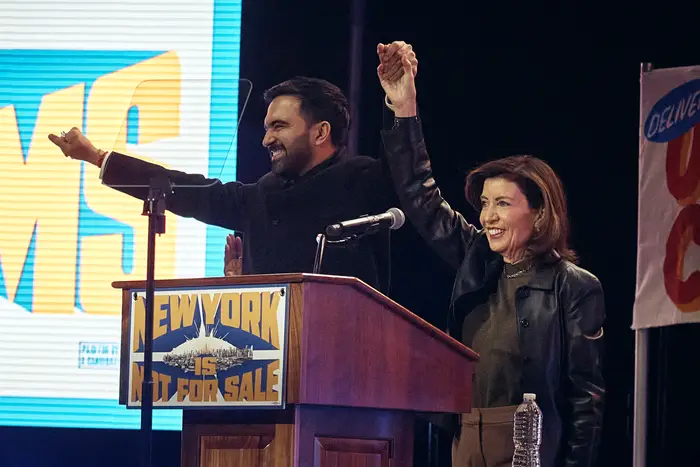
New York’s Governor Kathy Hochul has vetoed legislation that would have limited the mayor’s authority to reject proposed changes to the City Charter, effectively granting a significant advantage to mayor-elect Zohran Mamdani before he officially takes office. The veto, issued earlier this month, preserves Mamdani’s ability to implement his ambitious agenda without additional hurdles.
The legislation in question aimed to revoke the mayor’s power to block changes suggested by the City Council from appearing on the ballot. Had Hochul signed the bill into law, Mamdani would likely have faced complications in enacting his plans, which include significant reforms in city governance.
Implications of the Veto
Political analysts view Hochul’s veto as a strategic move to maintain executive power dynamics. Stephen Louis, counsel for the Center for New York City and State Law at New York Law School, emphasized that this action reflects a decision by one executive to bolster another’s authority. The veto increases the likelihood that several proposals from a City Council commission may not reach voters.
These proposals were largely prompted by concerns surrounding corruption scandals in Mayor Eric Adams‘ administration. Among the suggested changes is a measure that would enable voters to establish a process for removing a mayor found guilty of misconduct. Additionally, the Council sought greater control over high-ranking mayoral appointments. City Council Speaker Adrienne Adams expressed disappointment, stating, “There should be equal time and equal opportunity for ballot proposals from the co-governing branch of the city.”
In a previous move, Adams sidestepped the Council’s proposals by utilizing his own charter commission, which included measures aimed at expediting housing development. These measures were passed, resulting in substantial limitations on the Council’s authority over land-use decisions—a critical area of power for the legislative body.
Future Actions from Mamdani
Political observers predict that Mamdani may seek to present his own ballot questions, mirroring Adams’ approach. John Kaehny, head of the government watchdog group Reinvent Albany, noted that the governor’s veto might facilitate Mamdani’s establishment of a new charter commission, further sidelining the City Council’s proposals. This could mark the third consecutive year that the Council’s suggestions face rejection.
While both Hochul and Mamdani’s representatives have declined to comment on any discussions regarding the bill, the implications of the veto are significant for Mamdani’s policy ambitions. One potential initiative is the proposed Department of Community Safety, designed to address specific mental health emergencies, functioning independently of the New York Police Department. According to Alex Vitale, a sociology professor at Brooklyn College and advocate for the initiative, establishing this department would necessitate a change in the City Charter.
Despite the need for charter adjustments, some local officials believe that Mamdani could implement the department through an executive order. Julie Menin, a Councilmember anticipated to become the next Speaker, suggested this route at a recent panel discussion at New York Law School.
In her veto message, Hochul articulated her rationale, explaining that the proposed law could have far-reaching effects on the governance structures of the state’s other 61 cities. “This bill—seemingly prompted by concerns regarding New York City’s charter revision process—could reshape the relationship between the branches of government in cities throughout the state,” she noted.
As Mamdani prepares to assume office, the political landscape remains charged with implications for governance, accountability, and the balance of power within New York City.

Stanford Women Rally to Defeat Cal 78-69 in Thrilling Comeback

Eight Transformative Moments from Absolute Batman Revolutionize Character

Celene’s Angels Empowers Breast Cancer Patients with Support

Discover Unique Holiday Gift Ideas for Everyone on Your List

Keene Mobilizes for Civil War: A Community’s Response

Exploring Kindness: Nature’s Silent Connections and Human Moments

Cowboys Host Vikings in Crucial Week 15 Showdown on SNF

Chiefs’ Andy Reid Reveals Locker Room Mood After Crushing Loss

Urgent Rollover for U.S. Equity Index Futures Set for December 15

Inventor Achieves Breakthrough with 2 Billion FPS Laser Video

Charlie Sheen’s New Romance: ‘Glowing’ with Younger Partner

Community Unites for 7th Annual Into the Light Walk for Mental Health

Dua Lipa Aces GCSE Spanish, Sparks Super Bowl Buzz with Fans

Curium Group, PeptiDream, and PDRadiopharma Launch Key Cancer Trial

Israel Reopens Rafah Crossing After Hostage Remains Returned

Former Mozilla CMO Launches AI-Driven Cannabis Cocktail Brand Fast

Mother Fights to Reunite with Children After Kidnapping in New Drama

R&B Icon D’Angelo Dies at 51, Leaving Lasting Legacy
-
 Science2 months ago
Inventor Achieves Breakthrough with 2 Billion FPS Laser Video
-
 Top Stories2 months ago
Charlie Sheen’s New Romance: ‘Glowing’ with Younger Partner
-
 Health2 months ago
Community Unites for 7th Annual Into the Light Walk for Mental Health
-
 Entertainment2 months ago
Dua Lipa Aces GCSE Spanish, Sparks Super Bowl Buzz with Fans
-
 Health2 months ago
Curium Group, PeptiDream, and PDRadiopharma Launch Key Cancer Trial
-
 World2 months ago
Israel Reopens Rafah Crossing After Hostage Remains Returned
-
 Top Stories2 months ago
Former Mozilla CMO Launches AI-Driven Cannabis Cocktail Brand Fast
-
 Entertainment2 months ago
Mother Fights to Reunite with Children After Kidnapping in New Drama
-
 World2 months ago
R&B Icon D’Angelo Dies at 51, Leaving Lasting Legacy
-

 Business2 months ago
Tyler Technologies Set to Reveal Q3 Earnings on October 22
-

 Health2 months ago
North Carolina’s Biotech Boom: Billions in New Investments
-

 Health2 months ago
YouTube Launches New Mental Health Tools for Teen Users