
Science
Cosmic Airbursts: Invisible Explosions May Threaten Earth

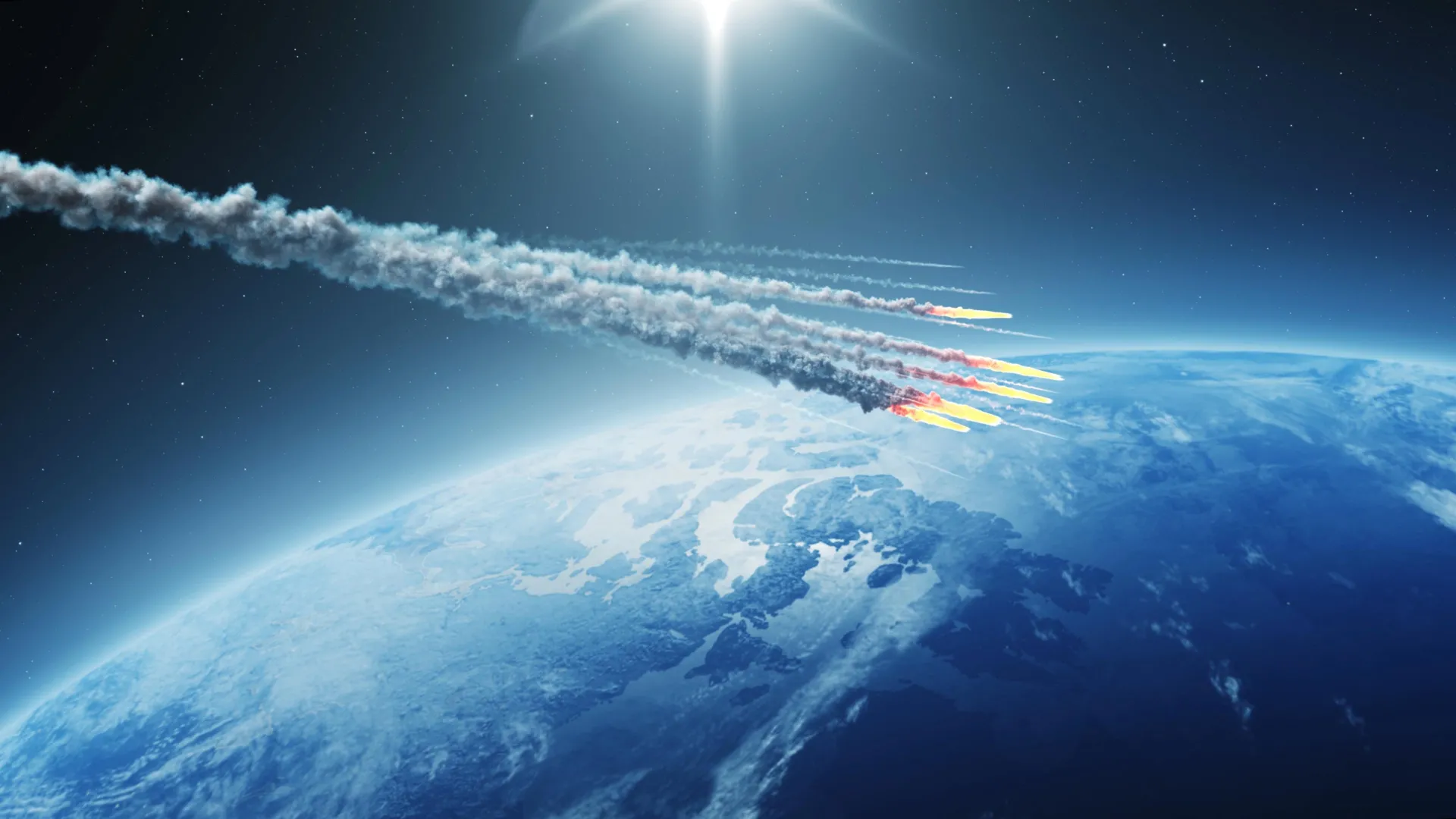
Recent research suggests that Earth has faced more frequent and potent “touchdown airbursts,” or explosions of comets and asteroids above its surface, than previously understood. These events, which release immense heat and pressure without leaving traditional impact craters, may pose a greater threat to our planet than once thought. A team led by James Kennett, an Emeritus Professor of Earth Science at the University of California – Santa Barbara, emphasizes the need for more scientific focus on these powerful phenomena.
Touchdown airbursts can cause severe damage, releasing shockwaves and extreme temperatures that affect vast areas. Unlike traditional impacts, which form craters, these airbursts leave minimal physical evidence, making detection challenging. “Touchdown events can cause extreme damage through very high temperatures and pressures,” Kennett explained. He noted that while they may create ephemeral disturbances, they do not result in the classic major craters associated with direct impacts.
New Insights from Marine Sediments
Recent studies by Kennett and his colleagues present compelling evidence for multiple airburst events throughout history. One significant finding, published in the journal PLOS One, connects airburst markers to the Younger Dryas Impact Hypothesis (YDIH). Researchers discovered these markers in marine sediments from Baffin Bay, located off Greenland’s western coast. This discovery marks the first evidence of the Younger Dryas cosmic impact event in marine records.
The Younger Dryas hypothesis posits that around 12,800 years ago, fragments of a comet exploded above Earth, initiating a dramatic global cooling period, which coincided with the extinction of several large species and shifts in human civilizations. As the comet fragmented, multiple explosions likely ignited widespread fires, resulting in a carbon-rich layer known as “black mat.” This layer, found primarily across the Northern Hemisphere, contains evidence such as platinum, iridium, and shocked quartz.
Kennett noted that “these materials do not directly measure the strength of the explosions, but they demonstrate how powerful and far-reaching the event was.” He added that the materials were propelled into the atmosphere and deposited globally, indicating their extensive impact.
The Challenge of Detecting Airbursts
Cosmic impacts range from the continuous fall of fine extraterrestrial dust to rare, massive collisions. Large impacts typically leave behind craters, providing clear evidence of their occurrence. In contrast, touchdown airbursts often fail to create lasting landscape changes, complicating their detection. As Kennett pointed out, “Previously, there has been no evidence for the Younger Dryas boundary (YDB) event of any crater or possible crater.”
A shallow seasonal lake near Perkins, Louisiana, may represent the first known crater associated with the Younger Dryas Boundary. This hypothesis was initially suggested in 1938 by a landowner who noted the lake’s circular shape. Detailed sediment studies began in 2006, and between then and 2024, researchers identified meltglass, spherules, and shocked quartz. Radiocarbon dating placed these materials within the Younger Dryas period, although further research is needed to validate the cosmic impact hypothesis.
Revisiting Historical Events
Shocked quartz is typically associated with significant impacts, but new research indicates that airbursts also produce a variety of fracture patterns. In two additional studies, the team examined samples from the Tunguska explosion in Siberia in 1908 and findings from Tall el-Hammam, an ancient city in the Levant believed to have been destroyed by a similar event approximately 3,600 years ago.
Tunguska is notable as the only recorded historical touchdown event, witnessed by people who described a bright fireball. Despite extensive studies focused on the forest damage, microscopic impact evidence had been largely overlooked until now. The researchers identified shocked quartz and tiny impact-formed spheres at the Tunguska site, alongside melted metal and carbon.
The team also strengthened the case for an airburst over Tall el-Hammam, documenting shocked quartz with diverse crack patterns, including straight, parallel fractures as well as curved and web-like features. These findings suggest intense pressures and complex blast directions similar to those observed at Tunguska.
In summary, the collective research indicates that cosmic impacts, particularly touchdown airbursts, may occur far more frequently than previously assumed. “They’re far more common, but also possess much more destructive potential than the more localized, classic crater-forming asteroidal impacts,” Kennett concluded. With their widespread destructive capabilities, these events warrant greater scientific investigation, highlighting their significance for humanity’s understanding of cosmic threats.

Blackstone Unveils Hilarious Holiday Video for 40th Anniversary

U.K. Investment Bank Targets U.S. Biotech Firms with New Funds

Colorado Buffaloes Clash with Stanford Cardinal in Phoenix Showdown

UK Minister Confirms Cyber-Attack Linked to Chinese Group

Kering SA Receives Mixed Analyst Ratings as Shares Decline

Todd Grisham Shares WWE Hazing Experience Amid Controversial Comments

New Technique Enhances Breast Cancer Surgery Experience for Patients

Evoplay Launches Urgent Penalty Shoot-Out: Cup Mania Ahead of World Cup

Trump Administration Moves to Dismantle NCAR, Forecasters Alarmed

Inventor Achieves Breakthrough with 2 Billion FPS Laser Video

Community Unites for 7th Annual Into the Light Walk for Mental Health

Charlie Sheen’s New Romance: ‘Glowing’ with Younger Partner

Dua Lipa Aces GCSE Spanish, Sparks Super Bowl Buzz with Fans

Curium Group, PeptiDream, and PDRadiopharma Launch Key Cancer Trial

Former Mozilla CMO Launches AI-Driven Cannabis Cocktail Brand Fast

Mother Fights to Reunite with Children After Kidnapping in New Drama

R&B Icon D’Angelo Dies at 51, Leaving Lasting Legacy

Israel Reopens Rafah Crossing After Hostage Remains Returned
-
 Science2 months ago
Inventor Achieves Breakthrough with 2 Billion FPS Laser Video
-
 Health2 months ago
Community Unites for 7th Annual Into the Light Walk for Mental Health
-
 Top Stories2 months ago
Charlie Sheen’s New Romance: ‘Glowing’ with Younger Partner
-
 Entertainment2 months ago
Dua Lipa Aces GCSE Spanish, Sparks Super Bowl Buzz with Fans
-
 Health2 months ago
Curium Group, PeptiDream, and PDRadiopharma Launch Key Cancer Trial
-
 Top Stories2 months ago
Former Mozilla CMO Launches AI-Driven Cannabis Cocktail Brand Fast
-
 Entertainment2 months ago
Mother Fights to Reunite with Children After Kidnapping in New Drama
-
 World2 months ago
R&B Icon D’Angelo Dies at 51, Leaving Lasting Legacy
-
 World2 months ago
Israel Reopens Rafah Crossing After Hostage Remains Returned
-

 Business2 months ago
Tyler Technologies Set to Reveal Q3 Earnings on October 22
-

 Health2 months ago
YouTube Launches New Mental Health Tools for Teen Users
-

 Entertainment2 months ago
Red Sox’s Bregman to Become Free Agent; Tigers Commit to Skubal