
Science
NASA’s Chandra Reveals Small Galaxies Lack Supermassive Black Holes

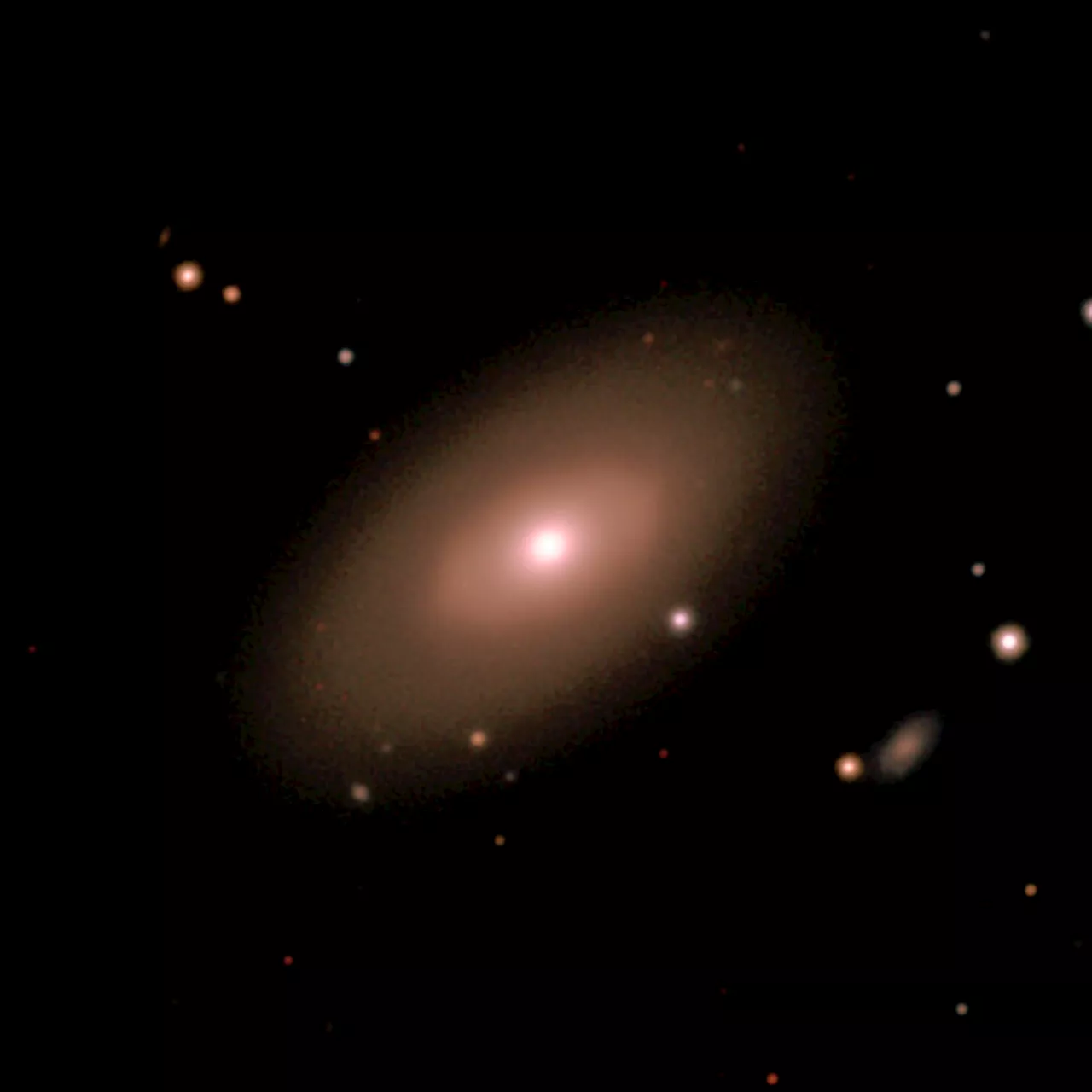
Recent research utilizing NASA’s Chandra X-ray Observatory indicates that most smaller galaxies likely do not harbor supermassive black holes at their centers. This study challenges the prevailing notion that nearly every galaxy hosts these colossal cosmic entities. The findings were based on an extensive analysis of over 1,600 galaxies collected over more than two decades of Chandra observations.
The study focused on various galaxies, ranging from massive ones with over ten times the mass of the Milky Way to dwarf galaxies, which possess stellar masses significantly less than that of our galaxy. Among the galaxies scrutinized, NGC 6278 and PGC 039620 stood out. The research revealed that while larger galaxies, including those comparable in size to the Milky Way, commonly exhibit evidence of supermassive black holes, smaller galaxies do not demonstrate the same trend.
According to Fan Zou, the lead researcher from the University of Michigan, understanding the prevalence of black holes in smaller galaxies is vital for grasping their formation. Zou stated, “It’s important to get an accurate black hole head count in these smaller galaxies. Our study gives clues about how supermassive black holes are born and provides essential hints about how often black hole signatures in dwarf galaxies can be found with new or future telescopes.”
When material falls towards black holes, it generates X-rays due to frictional heating. Many of the more massive galaxies in the study displayed bright X-ray sources, a clear indication of supermassive black holes. The researchers concluded that over 90% of massive galaxies, including those akin to the Milky Way, contain supermassive black holes. In contrast, smaller galaxies exhibited a notable absence of these strong X-ray signals.
The study specifically highlighted that galaxies with masses less than three billion solar masses—similar to the mass of the Large Magellanic Cloud—rarely contained bright X-ray sources. The researchers proposed two possible explanations for this phenomenon. The first suggests that the proportion of galaxies with massive black holes is significantly lower among these smaller galaxies. The second posits that the X-rays produced by matter falling into these black holes may be too faint for Chandra to detect.
Co-author Elena Gallo, also from the University of Michigan, emphasized the implications of the findings, stating, “We think, based on our analysis of the Chandra data, that there are indeed fewer black holes in these smaller galaxies than in their larger counterparts.”
To verify their conclusions, Zou and colleagues investigated both hypotheses regarding the lack of X-ray sources in smaller galaxies. The amount of gas swirling into a black hole determines its brightness in X-rays. As smaller black holes are expected to attract less gas than their larger counterparts, they tend to be less detectable. The researchers confirmed this expectation but found that the additional deficit of X-ray sources in less massive galaxies could not be solely explained by reduced gas inflow.
The study’s results suggest a genuine decrease in the number of black holes in smaller galaxies. This insight could significantly influence theories surrounding the formation of supermassive black holes. There are primarily two prevailing theories: the first posits that a giant gas cloud collapses directly into a black hole, starting with a mass thousands of times that of the Sun. The alternative theory suggests that supermassive black holes arise from the merger of smaller black holes created by the collapse of massive stars.
Co-author Anil Seth from the University of Utah noted that the formation of large black holes is expected to occur more frequently in the most massive galaxies. This observation aligns with the study’s findings, which indicate that smaller galaxies are less likely to host black holes.
The implications of this research extend to the potential rates of black hole mergers, particularly from collisions among dwarf galaxies. A lower number of black holes would likely result in fewer gravitational waves detectable by future observatories like the Laser Interferometer Space Antenna.
The Chandra X-ray Observatory program is managed by NASA’s Marshall Space Flight Center in Huntsville, Alabama, while the Smithsonian Astrophysical Observatory oversees its scientific operations from Cambridge, Massachusetts, and flight operations from Burlington, Massachusetts.
This study adds significant depth to our understanding of the relationship between galaxy size and black hole presence, opening new avenues for future research into the universe’s most enigmatic phenomena.

Massachusetts Tax Rebates Begin Today: Up to $7,000 for Some

NASA’s Chandra Reveals Small Galaxies Lack Supermassive Black Holes

Butte College Men’s Basketball Triumphs 83-60 in Conference Opener

Europe Faces Deepening Crisis Amidst Political and Economic Challenges

Trump’s Trade Deal Faces Criticism for Increasing Trade Deficit

Photographer’s Viral Laser Experiment Transforms Art Practice

Revitalize Your Skin: Expert Tips from Esthetician Ian Michael Crumm

TikTok’s Vintage Nail Polish Star Surges to 745K Followers!

Urgent Update: DNA Test Exonerates Man After 40 Years in Jail

Inventor Achieves Breakthrough with 2 Billion FPS Laser Video

Community Unites for 7th Annual Into the Light Walk for Mental Health

Charlie Sheen’s New Romance: ‘Glowing’ with Younger Partner

Dua Lipa Aces GCSE Spanish, Sparks Super Bowl Buzz with Fans

Curium Group, PeptiDream, and PDRadiopharma Launch Key Cancer Trial

Former Mozilla CMO Launches AI-Driven Cannabis Cocktail Brand Fast

Israel Reopens Rafah Crossing After Hostage Remains Returned

Mother Fights to Reunite with Children After Kidnapping in New Drama

R&B Icon D’Angelo Dies at 51, Leaving Lasting Legacy
-
 Science2 months ago
Inventor Achieves Breakthrough with 2 Billion FPS Laser Video
-
 Health2 months ago
Community Unites for 7th Annual Into the Light Walk for Mental Health
-
 Top Stories2 months ago
Charlie Sheen’s New Romance: ‘Glowing’ with Younger Partner
-
 Entertainment2 months ago
Dua Lipa Aces GCSE Spanish, Sparks Super Bowl Buzz with Fans
-
 Health2 months ago
Curium Group, PeptiDream, and PDRadiopharma Launch Key Cancer Trial
-
 Top Stories2 months ago
Former Mozilla CMO Launches AI-Driven Cannabis Cocktail Brand Fast
-
 World2 months ago
Israel Reopens Rafah Crossing After Hostage Remains Returned
-
 Entertainment2 months ago
Mother Fights to Reunite with Children After Kidnapping in New Drama
-
 World2 months ago
R&B Icon D’Angelo Dies at 51, Leaving Lasting Legacy
-

 Business2 months ago
Tyler Technologies Set to Reveal Q3 Earnings on October 22
-

 Health2 months ago
North Carolina’s Biotech Boom: Billions in New Investments
-

 Health2 months ago
YouTube Launches New Mental Health Tools for Teen Users