
Science
AI Steers Free-Flying Robot at International Space Station

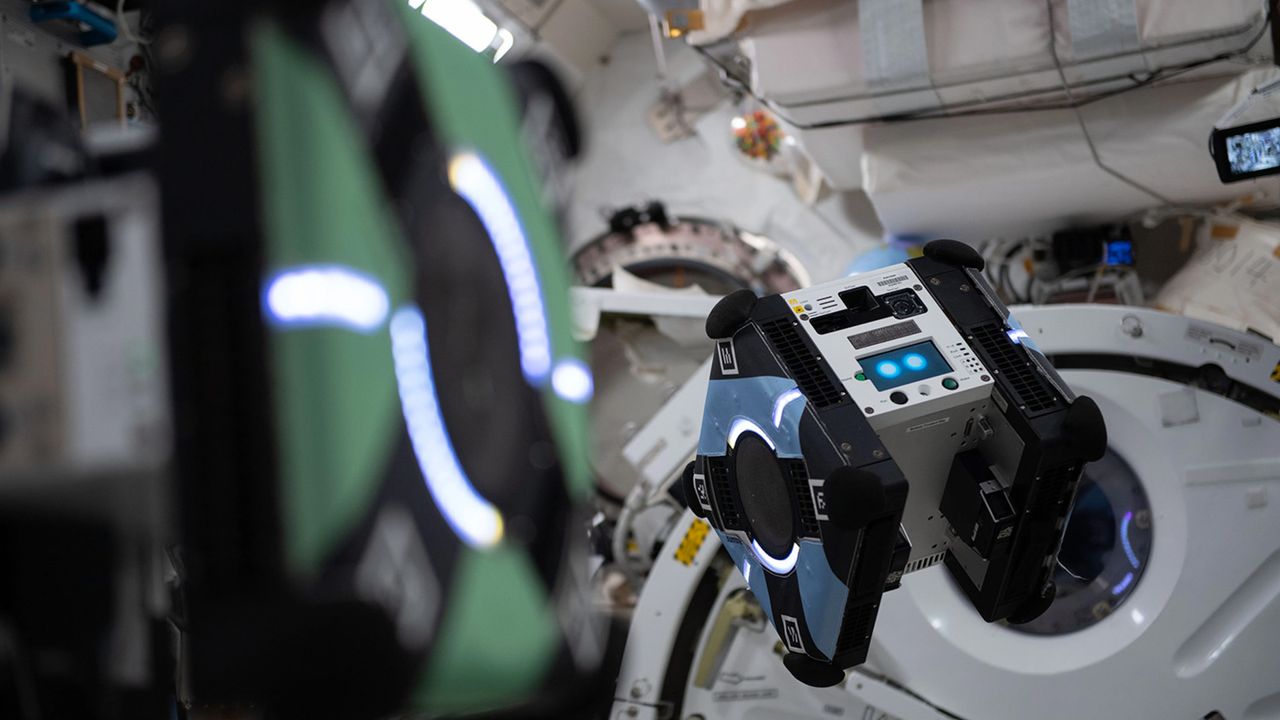
In a groundbreaking achievement, researchers at Stanford University have successfully utilized artificial intelligence to navigate a free-flying robot aboard the International Space Station (ISS) for the first time. This significant progress could lead to enhanced autonomy in future space missions, addressing challenges faced by robots in microgravity environments.
AI Enhances Robot Navigation
Traditionally, navigating the ISS has posed a significant challenge for both human astronauts and autonomous robots. The Stanford team collaborated with NASA on the Astrobee robot, demonstrating that a machine-learning system can efficiently plan safe routes through the ISS’s intricate modules. This innovation represents a crucial step toward enabling more autonomous robotic operations in space.
Lead researcher Somrita Banerjee, a Ph.D. candidate at Stanford, noted the complexities involved in motion planning within the station’s restricted space. Conventional algorithms often struggle when executed on older, radiation-hardened computers used in space. To overcome these limitations, the researchers implemented a standard optimization approach, as detailed in their recent paper presented at the International Conference on Space Robotics.
By breaking down complex motion-planning tasks into smaller, manageable steps, the team trained an AI model using thousands of pre-computed paths. This method allows the system to initiate new plans with an informed “warm start,” rather than recalculating from scratch. Banerjee explained, “Using a warm start is like planning a road trip by starting with a route that real people have driven before, rather than drawing a straight line across the map.”
Efficiency and Safety in Space Operations
This AI-driven method not only enhances computation speed but also incorporates strict safety checks. Tests conducted aboard the ISS showed that routes generated with the AI warm start were approximately 50% to 60% faster to compute than traditional planning methods. Banerjee remarked, “This is the first time AI has been used to help control a robot on the ISS. It shows that robots can move faster and more efficiently without sacrificing safety, which is essential for future missions where humans won’t always be able to guide them.”
Prior to the in-orbit trial, the system was validated at NASA’s Ames Research Center in Silicon Valley, where researchers used a granite table testbed to mimic the microgravity conditions of the ISS. During a four-hour session, astronauts performed a brief setup and left the Astrobee to be commanded remotely from NASA’s Johnson Space Center in Houston. Throughout the experiment, mission controllers directed the robot to fly 18 trajectories, each executed twice—with and without the AI-generated warm start. Additional virtual obstacles were implemented to ensure safety and prevent collisions.
Looking ahead, the Stanford team believes that similar AI-guided planning could enable robots to take on various tasks such as inspections, logistics, and scientific experiments on future missions to the Moon, Mars, and beyond. Banerjee emphasized the necessity of autonomy, stating, “As robots travel farther from Earth and as missions become more frequent and lower-cost, we won’t always be able to teleoperate them from the ground. Autonomy with built-in guarantees isn’t just helpful; it’s essential for the future of space robotics.”
The successful demonstration of AI in navigating the Astrobee robot marks a pivotal moment in the evolution of space robotics, potentially transforming how future missions are conducted in the challenging environment of space.

Senators Push Urgent Changes to Military Operations Bill After Deadly Crash

HomeAid Expands Reach with New Affiliate in Delaware Valley

Zelenskyy Highlights Territorial Disputes in U.S.-Led Peace Talks

AI Steers Free-Flying Robot at International Space Station

Fans Can Now Apply for Specific World Cup Match Tickets

Philippine Typhoon Survivors Take Legal Action Against Shell

Flavor Innovations and Trends to Define 2026 Beverage Market

Zelenskyy Urges Swift Action in U.S.-Led Peace Talks with Russia

Berkeley Hat Company to Close After 50 Years on Telegraph Ave

Inventor Achieves Breakthrough with 2 Billion FPS Laser Video

Community Unites for 7th Annual Into the Light Walk for Mental Health

Charlie Sheen’s New Romance: ‘Glowing’ with Younger Partner

Dua Lipa Aces GCSE Spanish, Sparks Super Bowl Buzz with Fans

Curium Group, PeptiDream, and PDRadiopharma Launch Key Cancer Trial

Former Mozilla CMO Launches AI-Driven Cannabis Cocktail Brand Fast

Israel Reopens Rafah Crossing After Hostage Remains Returned

Mother Fights to Reunite with Children After Kidnapping in New Drama

R&B Icon D’Angelo Dies at 51, Leaving Lasting Legacy
-
 Science2 months ago
Inventor Achieves Breakthrough with 2 Billion FPS Laser Video
-
 Health2 months ago
Community Unites for 7th Annual Into the Light Walk for Mental Health
-
 Top Stories2 months ago
Charlie Sheen’s New Romance: ‘Glowing’ with Younger Partner
-
 Entertainment2 months ago
Dua Lipa Aces GCSE Spanish, Sparks Super Bowl Buzz with Fans
-
 Health2 months ago
Curium Group, PeptiDream, and PDRadiopharma Launch Key Cancer Trial
-
 Top Stories2 months ago
Former Mozilla CMO Launches AI-Driven Cannabis Cocktail Brand Fast
-
 World2 months ago
Israel Reopens Rafah Crossing After Hostage Remains Returned
-
 Entertainment2 months ago
Mother Fights to Reunite with Children After Kidnapping in New Drama
-
 World2 months ago
R&B Icon D’Angelo Dies at 51, Leaving Lasting Legacy
-

 Business2 months ago
Tyler Technologies Set to Reveal Q3 Earnings on October 22
-

 Health2 months ago
YouTube Launches New Mental Health Tools for Teen Users
-
 Health2 months ago
North Carolina’s Biotech Boom: Billions in New Investments