
Science
Astronomers Discover Rings Forming Around Chiron for the First Time

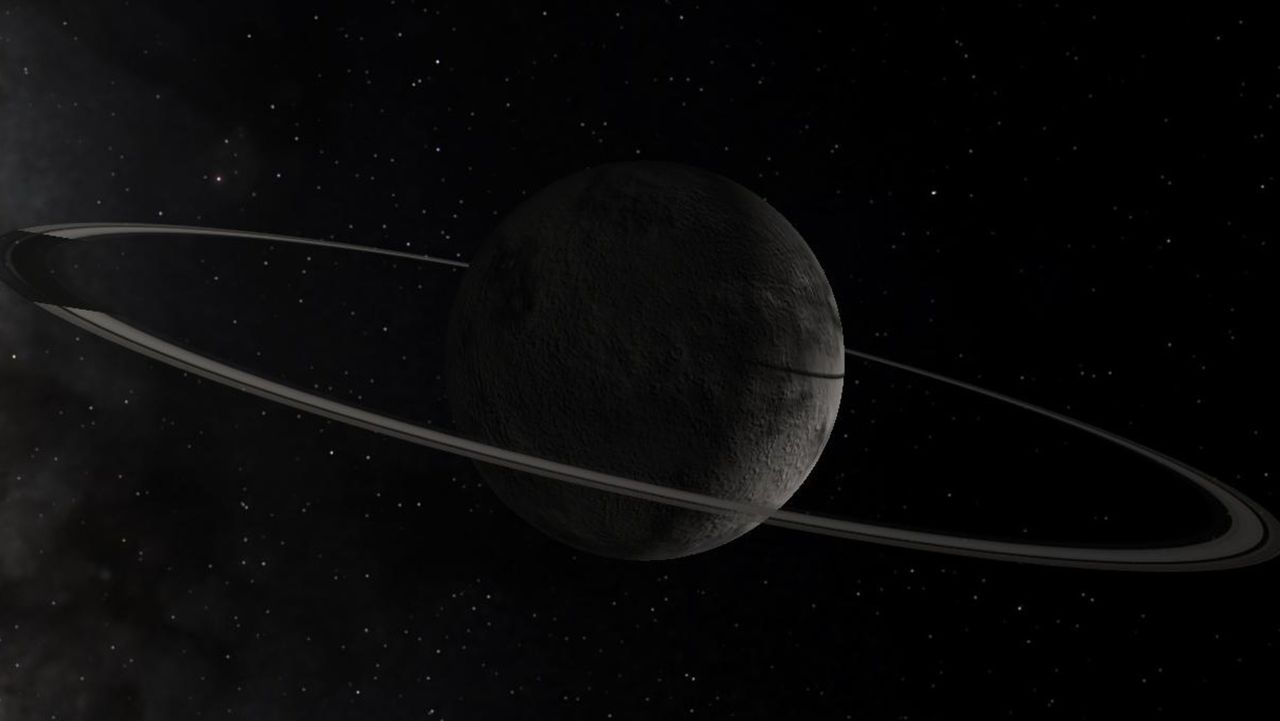
Astronomers have identified a remarkable phenomenon: four rings and diffuse material forming around the icy centaur known as 2060 Chiron, marking the first observation of a ring system in the process of formation. This significant discovery was made using data gathered at the Pico dos Dias Observatory in Brazil during 2023. Chiron, which orbits between Saturn and Uranus, was initially discovered in 1977 and is classified as a centaur, a type of celestial object that shares characteristics of both comets and asteroids.
Centaurs primarily reside between the orbits of Jupiter and Neptune. Chiron, approximately 200 kilometers (125 miles) in diameter, consists of a mixture of rock, water ice, and organic compounds. The newly discovered rings, thought to be composed of water ice and rocky materials likely resulting from a collision with another celestial body, orbit at distances of approximately 273 kilometers (170 miles), 325 kilometers (202 miles), 438 kilometers (272 miles), and 1,400 kilometers (870 miles) from Chiron’s center.
Notably, the outermost ring identified may not possess enough stability to be classified as a ring in the long term, necessitating further observation. What sets Chiron’s ring system apart is its ongoing formation, a phenomenon that has not been previously documented in astronomical research. By comparing the 2023 observations with earlier data from 2011, 2018, and 2022, researchers have noted that the ring system is evolving rapidly.
Astronomer Braga Ribas from the Federal University of Technology-Parana and co-author of the study published in the Astrophysical Journal Letters on October 14, 2025, emphasized the importance of this discovery. “It is an evolving system that will help us understand the dynamical mechanisms governing the creation of rings and satellites around small bodies, with potential implications for various types of disk dynamics in the universe,” he stated.
This groundbreaking observation not only enhances our understanding of Chiron but also contributes to the broader field of planetary science. The discovery highlights that ring systems are not exclusive to larger gas giants such as Saturn, Jupiter, Uranus, and Neptune, but can also form around smaller celestial bodies. With other dwarf planets like Haumea and Quaoar, as well as centaur Chariklo, already known to possess rings, Chiron’s rings add to the growing list of celestial objects with complex ring systems that challenge our understanding of planetary formation and evolution.
As astronomers continue to monitor Chiron and its developing rings, the insights gained will likely shape future explorations into the dynamics of ring formation across various celestial environments.

HomeAid Expands Reach with New Affiliate in Delaware Valley

Zelenskyy Highlights Territorial Disputes in U.S.-Led Peace Talks

AI Steers Free-Flying Robot at International Space Station

Fans Can Now Apply for Specific World Cup Match Tickets

Philippine Typhoon Survivors Take Legal Action Against Shell

Flavor Innovations and Trends to Define 2026 Beverage Market

Zelenskyy Urges Swift Action in U.S.-Led Peace Talks with Russia

Berkeley Hat Company to Close After 50 Years on Telegraph Ave

Urgent Recall: Nasal Spray Contaminated, Nationwide Distribution Affected

Inventor Achieves Breakthrough with 2 Billion FPS Laser Video

Community Unites for 7th Annual Into the Light Walk for Mental Health

Charlie Sheen’s New Romance: ‘Glowing’ with Younger Partner

Dua Lipa Aces GCSE Spanish, Sparks Super Bowl Buzz with Fans

Curium Group, PeptiDream, and PDRadiopharma Launch Key Cancer Trial

Former Mozilla CMO Launches AI-Driven Cannabis Cocktail Brand Fast

Israel Reopens Rafah Crossing After Hostage Remains Returned

Mother Fights to Reunite with Children After Kidnapping in New Drama

R&B Icon D’Angelo Dies at 51, Leaving Lasting Legacy
-
 Science2 months ago
Inventor Achieves Breakthrough with 2 Billion FPS Laser Video
-
 Health2 months ago
Community Unites for 7th Annual Into the Light Walk for Mental Health
-
 Top Stories2 months ago
Charlie Sheen’s New Romance: ‘Glowing’ with Younger Partner
-
 Entertainment2 months ago
Dua Lipa Aces GCSE Spanish, Sparks Super Bowl Buzz with Fans
-
 Health2 months ago
Curium Group, PeptiDream, and PDRadiopharma Launch Key Cancer Trial
-
 Top Stories2 months ago
Former Mozilla CMO Launches AI-Driven Cannabis Cocktail Brand Fast
-
 World2 months ago
Israel Reopens Rafah Crossing After Hostage Remains Returned
-
 Entertainment2 months ago
Mother Fights to Reunite with Children After Kidnapping in New Drama
-
 World2 months ago
R&B Icon D’Angelo Dies at 51, Leaving Lasting Legacy
-

 Business2 months ago
Tyler Technologies Set to Reveal Q3 Earnings on October 22
-

 Health2 months ago
YouTube Launches New Mental Health Tools for Teen Users
-

 Health2 months ago
North Carolina’s Biotech Boom: Billions in New Investments