
Politics
Thailand’s Political Landscape Shifts Ahead of February 8 Elections

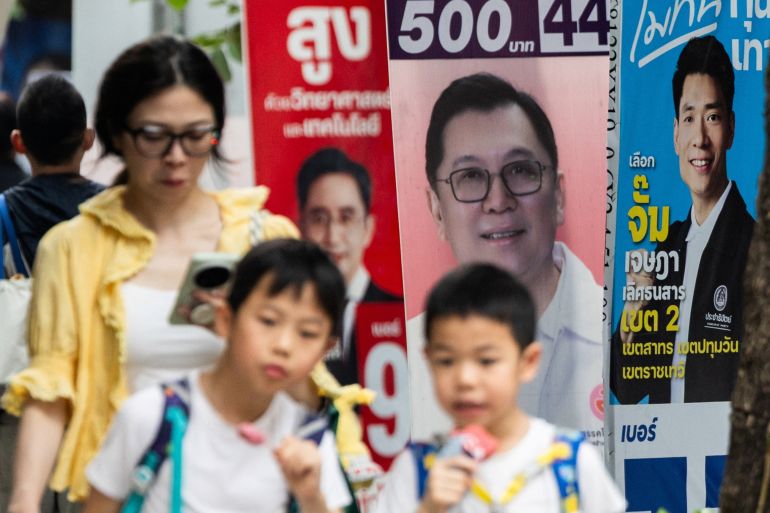
Voters in Thailand are preparing to participate in a crucial election on February 8, 2026, amidst a backdrop of significant political turbulence. The country has witnessed the appointment of three different prime ministers over the last three years, while recent border clashes with Cambodia have resulted in 149 fatalities. This election is seen as a pivotal moment that could either reinforce the nation’s longstanding political cycles or pave the way for substantive change.
The upcoming snap elections will feature a contest primarily between Prime Minister Anutin Charnvirakul’s Bhumjaithai party and the progressive, youth-led People’s Party. Bhumjaithai, which has garnered support from Thailand’s royalist conservative establishment, has transformed itself from a minor player into a formidable political force. Meanwhile, the People’s Party, a successor to the group that won the last election but was barred from power due to legal challenges, aims to disrupt the status quo with a platform focused on reforming the monarchy and reducing the influence of unelected institutions.
Key Players and Their Platforms
Bhumjaithai was propelled into the political spotlight during the 2019 elections, initially leveraging its support for medical marijuana to win popularity. Since then, it has evolved into a staunch defender of the monarchy and now seeks to secure a dominant position in parliament. The party has undergone a significant rebranding, positioning itself against any reforms to the lese-majeste laws, which criminalize defamation of the monarchy. Anutin has pledged to bolster national security and stimulate economic growth, setting ambitious targets for annual growth rates.
Conversely, the People’s Party represents a new wave of political reform, advocating for a reduction in military and judicial power. This party has shifted its approach on the lese-majeste law, softening its previous demands during the current campaign. According to Thitinan Pongsudhirak, a professor of international relations at Chulalongkorn University, the People’s Party distinguishes itself by prioritizing reform ideas over traditional patronage-based politics.
Pheu Thai, a party with a long history in Thai politics, is also aiming for a comeback after experiencing significant setbacks, including the removal of two prime ministers linked to its ranks and the imprisonment of its founder, Thaksin Shinawatra. Despite these challenges, Pheu Thai continues to hold considerable influence, particularly in northern and northeastern Thailand, where it maintains a robust electoral machinery. The party is campaigning on themes of debt relief and economic support for low-income individuals, complemented by an innovative “millionaire maker” program promising substantial cash prizes.
Electoral Mechanics and Voter Engagement
Approximately 53 million eligible voters will cast their ballots in this election, which will fill all 500 seats in the House of Representatives through a mixed electoral system. Four hundred of these seats will be filled using a first-past-the-post approach, while the remaining one hundred will be allocated through proportional representation. Notably, the appointed Senate will not participate in the selection of the next prime minister, a departure from previous elections.
Polling stations will open at 08:00 local time and close at 17:00. The initial results are expected to emerge shortly after the polls close, with early indications of voter turnout suggesting high engagement; around 87 percent of registered advance voters in Bangkok participated in early voting.
Recent polling data indicates that the People’s Party is currently leading in public support, with its leader Natthaphong Ruengpanyawut garnering 29.1 percent of preferences for prime minister, compared to Anutin at 22.4 percent and Pheu Thai’s Yodchanan Wongsawat in fourth place. For party lists, the People’s Party is ahead with 34.2 percent of the vote, followed by Bhumjaithai at 22.6 percent and Pheu Thai at 16.2 percent.
The elections also include a referendum on whether to rewrite the constitution, which was enacted under military rule in 2017. While polling suggests considerable support for this initiative, the actual process of constitutional reform remains complex and uncertain, necessitating parliamentary action and potential public votes on key amendments.
As the election approaches, the implications of recent border tensions with Cambodia loom large. The clashes earlier in the year have heightened nationalist sentiments, which may influence voter behaviors, particularly in favor of Bhumjaithai. Political analysts predict that these dynamics could significantly affect the performance of the Pheu Thai party, which has faced scrutiny over its connections to Cambodian leadership.
Given the fragmented nature of the political landscape, coalition-building will be essential for any party seeking to form a government. However, experts caution that the resulting alliances are unlikely to be stable, as political history in Thailand has shown that such partnerships often falter. The outcome of this election could potentially reshape Thailand’s political future, but the entrenched nature of established powers raises questions about the sustainability of any new governance model.
With the elections on the horizon, all eyes are on Thailand as it navigates this critical juncture in its political journey. The results will not only determine the composition of the next government but may also signal whether the country can break free from its cycle of political upheaval.

Funko’s Price Target Increased to $4.00 as Analysts React

Humboldt Celebrates as ‘One Battle After Another’ Claims Best Picture

GSK Faces Backlash Over Asthma Inhaler Scrapping, Children Suffer

Adorable Sandhill Crane Colt Hugs Mom in The Villages

USA Unveils Star-Spangled Jerseys Ahead of March Friendlies

Newport Plans Colorful Lighting for Fourth Street Bridge

Sandia Scientists Honored for Innovative Career Journeys

Urgent: Charles M. Payment Passes Away at 78, Memorial Details Inside

NFL Free Agency: Key Moves and Player Signings in Week One

Researchers Launch $1.25M Project for Real-Time Hazard Monitoring in Hawaiʻi

Send It South Revives Culture and Community at The Momentary

UK Government Borrowing Hits £20.2 Billion in September Surge

Flipkart Republic Day Sale: iPhone 16 Plus Price Slashed by ₹23,900

Adecco SA Secures Mixed Ratings from Analysts Amid Earnings Update

Researchers Achieve Record 15.1 mA/cm² Hydrogen Production Efficiency

Globant Reveals Key Tech Forces Shaping Business in 2026

Dua Lipa Aces GCSE Spanish, Sparks Super Bowl Buzz with Fans

Inventor Achieves Breakthrough with 2 Billion FPS Laser Video
-
 Science8 months ago
Researchers Launch $1.25M Project for Real-Time Hazard Monitoring in Hawaiʻi
-
 Entertainment7 months ago
Send It South Revives Culture and Community at The Momentary
-
 World10 months ago
UK Government Borrowing Hits £20.2 Billion in September Surge
-
 Business6 months ago
Flipkart Republic Day Sale: iPhone 16 Plus Price Slashed by ₹23,900
-
 Sports8 months ago
Adecco SA Secures Mixed Ratings from Analysts Amid Earnings Update
-
 Top Stories5 months ago
Researchers Achieve Record 15.1 mA/cm² Hydrogen Production Efficiency
-
 Business8 months ago
Globant Reveals Key Tech Forces Shaping Business in 2026
-
 Entertainment10 months ago
Dua Lipa Aces GCSE Spanish, Sparks Super Bowl Buzz with Fans
-
 Science10 months ago
Inventor Achieves Breakthrough with 2 Billion FPS Laser Video
-

 Top Stories10 months ago
Charlie Sheen’s New Romance: ‘Glowing’ with Younger Partner
-

 Top Stories8 months ago
JSerra Names Hardy Nickerson as First Black Football Coach
-

 Health10 months ago
Community Unites for 7th Annual Into the Light Walk for Mental Health