
Science
China Advances Lunar Ambitions with Successful Rocket Test

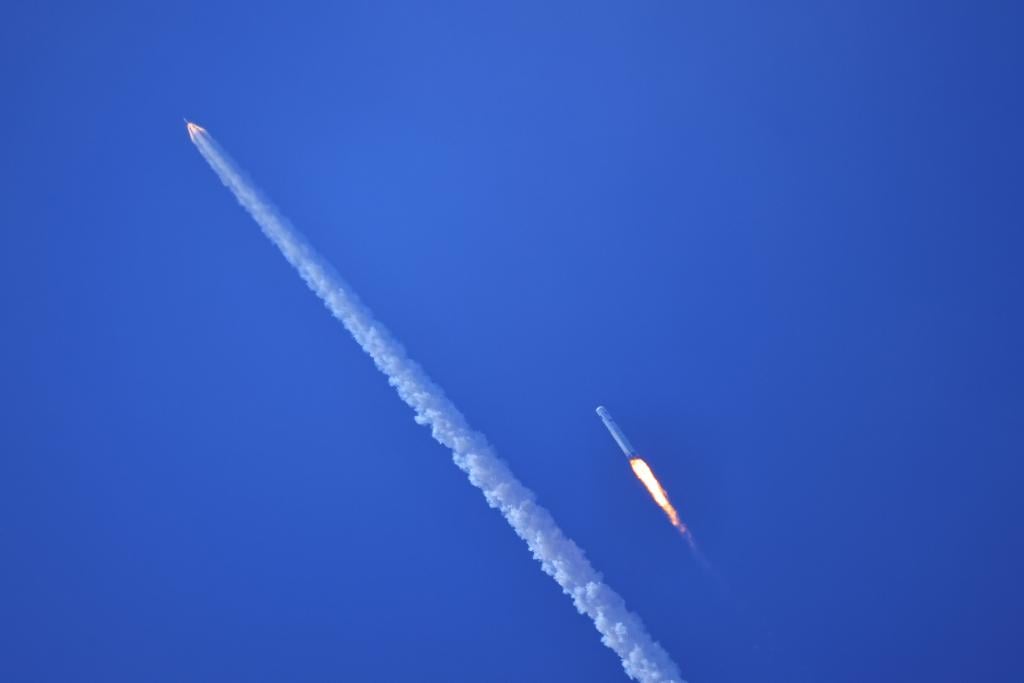
China has made significant strides in its space exploration efforts, underscored by a successful test of its Long March-10 rocket and the Mengzhou spacecraft. This achievement positions the country closer to its ambitious goal of establishing a lunar outpost by 2030, in direct competition with NASA’s Artemis Program.
On February 11, 2026, the China Manned Spaceflight Agency (CMSA) conducted a critical flight test at the Wenchang Spacecraft Launch Site located in southern Hainan Province. This test involved both a low-altitude demonstration of the Long March-10 rocket and an in-flight abort test of the Mengzhou spacecraft. The mission marked the first ignition flight of the Long March-10 and successfully navigated the maximum dynamic pressure phase, known as Max Q, which is one of the most challenging stages of rocket ascent.
The in-flight abort test assessed the safety systems of the Mengzhou capsule, designed to ensure the crew’s safety in emergency situations. Both the rocket and the crew capsule performed as intended, landing successfully in their designated recovery areas after completing their respective missions.
Ji Qiming, a spokesperson for the CMSA, explained the importance of the Long March-10 rocket, stating, “The Long March-10 is a next-generation partially reusable launch system designed for crewed lunar missions.” The rocket is available in two configurations: one featuring three stages and two strap-on boosters, akin to SpaceX’s Falcon 9, while the second configuration, known as the 10A, consists of two stages without boosters.
The Long March-10 is powered by seven liquid oxygen (LOX) and kerosene engines, emphasizing its capability to support complex missions. The Mengzhou spacecraft, translating to “Dream Vessel,” is designed to carry six to seven taikonauts and is engineered for reuse.
Following the separation of the Mengzhou spacecraft, the Long March-10 continued its ascent until it reached its planned altitude and speed. The rocket then entered a glide phase, adjusting its orientation multiple times before deploying its four grid fins in preparation for landing. During the descent, two engines were reignited to facilitate powered deceleration, followed by an aerodynamic deceleration phase, which relied on the grid fins for control.
As the rocket approached the final landing phase, three engines were reignited. The rocket hovered just above sea level while ground crews tested an onboard tether mechanism, simulating a recovery operation that utilizes a ground-based net system. Ultimately, the rocket splashed down in the ocean, where recovery teams successfully retrieved it.
This successful test represents a significant step toward China’s goal of landing astronauts on the Moon by 2030. Zhu Pingping from the China Aerospace Science and Technology Corporation remarked that this achievement enhances China’s prospects of sending crews not only to the Moon but also to other potential destinations in deep space, such as Mars.
In addition to its lunar ambitions, China is expanding its capabilities with the planned development of the Tiangong space station, alongside robotic missions aimed at exploring Near Earth Asteroids and conducting Mars sample return missions. As these initiatives progress, China is positioning itself as a formidable player in the global space arena.
The recent tests highlight the rapid advancements in China’s space program and its commitment to achieving its long-term goals in lunar exploration and beyond.

Funko’s Price Target Increased to $4.00 as Analysts React

Humboldt Celebrates as ‘One Battle After Another’ Claims Best Picture

GSK Faces Backlash Over Asthma Inhaler Scrapping, Children Suffer

Adorable Sandhill Crane Colt Hugs Mom in The Villages

USA Unveils Star-Spangled Jerseys Ahead of March Friendlies

Newport Plans Colorful Lighting for Fourth Street Bridge

Sandia Scientists Honored for Innovative Career Journeys

Urgent: Charles M. Payment Passes Away at 78, Memorial Details Inside

NFL Free Agency: Key Moves and Player Signings in Week One

Researchers Launch $1.25M Project for Real-Time Hazard Monitoring in Hawaiʻi

Send It South Revives Culture and Community at The Momentary

UK Government Borrowing Hits £20.2 Billion in September Surge

Flipkart Republic Day Sale: iPhone 16 Plus Price Slashed by ₹23,900

Adecco SA Secures Mixed Ratings from Analysts Amid Earnings Update

Researchers Achieve Record 15.1 mA/cm² Hydrogen Production Efficiency

Globant Reveals Key Tech Forces Shaping Business in 2026

Inventor Achieves Breakthrough with 2 Billion FPS Laser Video

Dua Lipa Aces GCSE Spanish, Sparks Super Bowl Buzz with Fans
-
 Science8 months ago
Researchers Launch $1.25M Project for Real-Time Hazard Monitoring in Hawaiʻi
-
 Entertainment7 months ago
Send It South Revives Culture and Community at The Momentary
-
 World9 months ago
UK Government Borrowing Hits £20.2 Billion in September Surge
-
 Business6 months ago
Flipkart Republic Day Sale: iPhone 16 Plus Price Slashed by ₹23,900
-
 Sports7 months ago
Adecco SA Secures Mixed Ratings from Analysts Amid Earnings Update
-
 Top Stories5 months ago
Researchers Achieve Record 15.1 mA/cm² Hydrogen Production Efficiency
-
 Business8 months ago
Globant Reveals Key Tech Forces Shaping Business in 2026
-
 Science9 months ago
Inventor Achieves Breakthrough with 2 Billion FPS Laser Video
-
 Entertainment10 months ago
Dua Lipa Aces GCSE Spanish, Sparks Super Bowl Buzz with Fans
-

 Top Stories10 months ago
Charlie Sheen’s New Romance: ‘Glowing’ with Younger Partner
-

 Top Stories7 months ago
JSerra Names Hardy Nickerson as First Black Football Coach
-

 Health10 months ago
Community Unites for 7th Annual Into the Light Walk for Mental Health