
Business
Oil Prices Surge Over 10% Amid Middle East Conflict Escalation

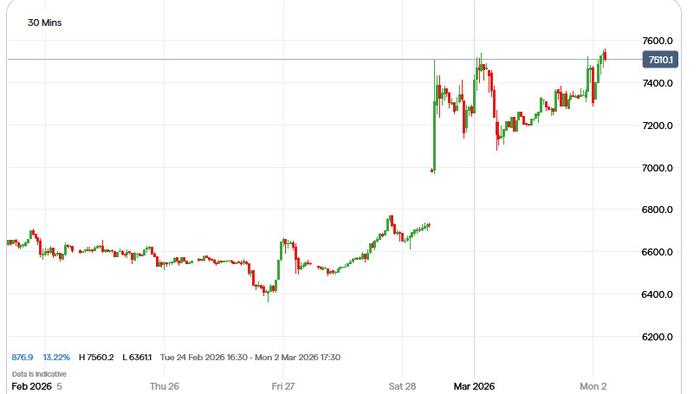
Oil prices have surged over 10% in over-the-counter trading, reflecting heightened tensions in the Middle East. As conflict escalates, particularly in the Straits of Hormuz—responsible for approximately 20% of global oil transit—investors are closely monitoring the situation. Following the attacks on at least three vessels in the area, futures trading is poised to open with spot West Texas Intermediate (WTI) prices around $75 and Brent crude expected to exceed $80.
The immediate concern for traders is not just the opening price but the medium and long-term implications of the ongoing conflict. The spike in oil prices comes despite a modest supply increase announced by OPEC+. Market analysts indicate that for these gains to be sustainable, investors will need to consider the likelihood of a prolonged conflict.
Market Reactions and Historical Context
The current situation is markedly different from past conflicts, particularly the 2003 invasion of Iraq. During that period, oil prices initially fell as speculation grew that the U.S.-led forces would achieve a quick victory. However, prices later rebounded as it became clear that stability would not be easily attained. This time, the stakes are considerably higher; Iran’s oil output capacity surpasses that of Iraq during the earlier conflict, and its ability to threaten the Straits of Hormuz adds a layer of complexity that traders cannot ignore.
According to Matt Smith, an oil analyst at Kpler, “Tankers are starting to build by the Strait of Hormuz, but nothing seems to be going through at the moment—tankers are definitely spooked.” This indicates that any uncertainty regarding the conflict’s resolution could lead to sustained price increases in crude oil.
Future Price Predictions and Scenarios
Analysts are divided on the potential price trajectory of oil. Some foresee prices escalating beyond $100 per barrel if the conflict intensifies. Helima Croft, a veteran OPEC analyst from RBC, has warned that a war targeting Iran could result in significant price increases. Similarly, forecasts from Barclays suggest that oil could reach $100 depending on how the situation evolves.
On the more conservative side, Andy Lipow, president of Lipow Oil Associates, estimates that prices will rise by at least $3 to $5 per barrel when trading resumes. He also outlined a worst-case scenario where an attack by Iran on Saudi oil infrastructure could lead to price spikes of $10 to $20. Lipow assigned this scenario a 33% likelihood, emphasizing the unpredictable nature of the current conflict.
The ongoing conflict has already expanded in scope compared to earlier skirmishes. Iran’s military responses are expected to escalate and could involve targeting U.S. bases and regional shipping routes. The Houthis in Yemen have indicated plans to resume disruptive activities in the region, further complicating the situation.
As the conflict continues, the oil market remains highly reactive. The price will ultimately depend on how the war stabilizes. Recent comments from former U.S. President Donald Trump, suggesting the possibility of negotiations with Iran, offer a glimmer of hope for de-escalation. Trump indicated, “They want to talk, and I have agreed to talk,” which could potentially lead to a resolution that avoids severe disruption in oil supply.
With uncertainty hanging over the market, traders are buying oil now and pondering the implications later. The dynamics of this conflict are shaping what could be a volatile period for oil prices, significantly impacting both global markets and economies reliant on stable energy costs.

Funko’s Price Target Increased to $4.00 as Analysts React

Humboldt Celebrates as ‘One Battle After Another’ Claims Best Picture

GSK Faces Backlash Over Asthma Inhaler Scrapping, Children Suffer

Adorable Sandhill Crane Colt Hugs Mom in The Villages

USA Unveils Star-Spangled Jerseys Ahead of March Friendlies

Newport Plans Colorful Lighting for Fourth Street Bridge

Sandia Scientists Honored for Innovative Career Journeys

Urgent: Charles M. Payment Passes Away at 78, Memorial Details Inside

NFL Free Agency: Key Moves and Player Signings in Week One

Researchers Launch $1.25M Project for Real-Time Hazard Monitoring in Hawaiʻi

Send It South Revives Culture and Community at The Momentary

UK Government Borrowing Hits £20.2 Billion in September Surge

Flipkart Republic Day Sale: iPhone 16 Plus Price Slashed by ₹23,900

Adecco SA Secures Mixed Ratings from Analysts Amid Earnings Update

Researchers Achieve Record 15.1 mA/cm² Hydrogen Production Efficiency

Globant Reveals Key Tech Forces Shaping Business in 2026

Dua Lipa Aces GCSE Spanish, Sparks Super Bowl Buzz with Fans

Inventor Achieves Breakthrough with 2 Billion FPS Laser Video
-
 Science8 months ago
Researchers Launch $1.25M Project for Real-Time Hazard Monitoring in Hawaiʻi
-
 Entertainment7 months ago
Send It South Revives Culture and Community at The Momentary
-
 World10 months ago
UK Government Borrowing Hits £20.2 Billion in September Surge
-
 Business6 months ago
Flipkart Republic Day Sale: iPhone 16 Plus Price Slashed by ₹23,900
-
 Sports8 months ago
Adecco SA Secures Mixed Ratings from Analysts Amid Earnings Update
-
 Top Stories5 months ago
Researchers Achieve Record 15.1 mA/cm² Hydrogen Production Efficiency
-
 Business8 months ago
Globant Reveals Key Tech Forces Shaping Business in 2026
-
 Entertainment10 months ago
Dua Lipa Aces GCSE Spanish, Sparks Super Bowl Buzz with Fans
-
 Science10 months ago
Inventor Achieves Breakthrough with 2 Billion FPS Laser Video
-

 Top Stories10 months ago
Charlie Sheen’s New Romance: ‘Glowing’ with Younger Partner
-

 Top Stories8 months ago
JSerra Names Hardy Nickerson as First Black Football Coach
-

 Health10 months ago
Community Unites for 7th Annual Into the Light Walk for Mental Health