
Politics
Kazakhstan Votes on Constitutional Changes to Boost Presidential Power

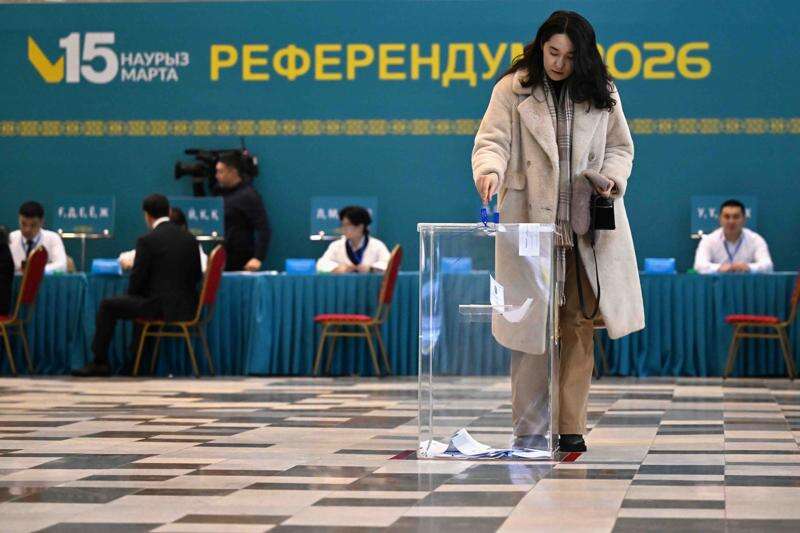
Voters in Kazakhstan participated in a referendum on February 25, 2024, aimed at adopting a new constitution that would significantly enhance the authority of President Kassym-Jomart Tokayev. This proposed constitutional change seeks to consolidate power by merging the parliament’s two chambers into one and granting the president the authority to appoint all government officials, including reinstating the role of vice-president.
Critics of the amendments argue that they may undermine democratic processes. Mario Bikarski, a Senior Eastern Europe and Central Asia Analyst at the risk intelligence firm Verisk Maplecroft, expressed concerns that “the transition to a single-chamber parliament will not necessarily strengthen democracy.” He highlighted a growing public demand for increased political accountability, which he believes the proposed changes are unlikely to satisfy.
If approved, the new constitution will also create a body known as the People’s Council, which will have the power to initiate legislation and conduct referendums. Notably, all members of this council will be appointed by the president, further consolidating power within the executive branch. This marks the second constitutional change initiated by Tokayev in four years, raising questions about his intentions regarding future political maneuvering.
Tokayev, a former Soviet official and diplomat who previously served at the United Nations, is currently limited to one seven-year term, expiring in 2029. Analysts suggest that the referendum could provide a mechanism for him to reset presidential term limits. Temur Umarov, a fellow at the Carnegie Russia Eurasia Center, noted, “If the transition of power doesn’t go as Tokayev would like, then he will be able to say that with the adoption of the new Constitution, we have reset presidential term limits.”
This pattern of amending constitutions to alter term limits has been observed among leaders of several former Soviet republics, including Russia, Belarus, Uzbekistan, and Tajikistan. In addition to the consolidation of political power, the proposed constitution includes a stipulation that marriage will be defined as a union between a man and a woman. Analysts view this change as a response to a law that bans what authorities classify as “propaganda” of LGBTQ+ relations.
Umarov commented on this trend, stating, “What we previously saw in the Russian Constitution has migrated to the Kazakhstani one.” He suggested that this shift towards “traditionalism” indicates a potential future direction for the Kazakhstani political regime.
Tokayev has framed the constitutional changes as necessary for making swift decisions in an increasingly complex geopolitical landscape. “This step is of exceptional importance, especially in the current period, when the geopolitical situation is unstable and challenges and threats to national security are becoming increasingly tangible,” he stated at a forum in Astana.
The political climate in Kazakhstan is complicated by economic challenges, including an inflation rate that reached 11.7% in February. Analysts warn that these economic issues could trigger unrest similar to the nationwide protests in 2022, which were sparked by rising fuel prices and resulted in significant casualties among both protesters and police. Tokayev’s consolidation of power appears to be a strategy to prevent a repeat of such unrest.
“The prevention of another wave of unrest remains a key priority for Tokayev,” Bikarski noted, emphasizing that Kazakhstan currently ranks as the highest-risk country in Central Asia on the predictive Civil Unrest Index. This situation reflects a growing incidence of industrial action, particularly in oil-producing regions.
As the referendum unfolds, the opposition in Kazakhstan remains fragmented and largely unrepresented within government structures. Despite efforts from some opposition-minded politicians and civil society activists to rally public sentiment against the amendments, they have struggled to make a significant impact in the month leading up to the vote.
Analysts underscore the challenges faced by these factions in influencing public opinion, with Umarov stating, “There’s no formally formed opposition in Kazakhstan.” As such, the outcome of the referendum could further solidify Tokayev’s authority and reshape the political landscape in Kazakhstan for years to come.

Funko’s Price Target Increased to $4.00 as Analysts React

Humboldt Celebrates as ‘One Battle After Another’ Claims Best Picture

GSK Faces Backlash Over Asthma Inhaler Scrapping, Children Suffer

Adorable Sandhill Crane Colt Hugs Mom in The Villages

USA Unveils Star-Spangled Jerseys Ahead of March Friendlies

Newport Plans Colorful Lighting for Fourth Street Bridge

Sandia Scientists Honored for Innovative Career Journeys

Urgent: Charles M. Payment Passes Away at 78, Memorial Details Inside

NFL Free Agency: Key Moves and Player Signings in Week One

Researchers Launch $1.25M Project for Real-Time Hazard Monitoring in Hawaiʻi

Send It South Revives Culture and Community at The Momentary

UK Government Borrowing Hits £20.2 Billion in September Surge

Flipkart Republic Day Sale: iPhone 16 Plus Price Slashed by ₹23,900

Adecco SA Secures Mixed Ratings from Analysts Amid Earnings Update

Globant Reveals Key Tech Forces Shaping Business in 2026

Researchers Achieve Record 15.1 mA/cm² Hydrogen Production Efficiency

Inventor Achieves Breakthrough with 2 Billion FPS Laser Video

Dua Lipa Aces GCSE Spanish, Sparks Super Bowl Buzz with Fans
-
 Science8 months ago
Researchers Launch $1.25M Project for Real-Time Hazard Monitoring in Hawaiʻi
-
 Entertainment7 months ago
Send It South Revives Culture and Community at The Momentary
-
 World9 months ago
UK Government Borrowing Hits £20.2 Billion in September Surge
-
 Business6 months ago
Flipkart Republic Day Sale: iPhone 16 Plus Price Slashed by ₹23,900
-
 Sports8 months ago
Adecco SA Secures Mixed Ratings from Analysts Amid Earnings Update
-
 Business8 months ago
Globant Reveals Key Tech Forces Shaping Business in 2026
-
 Top Stories5 months ago
Researchers Achieve Record 15.1 mA/cm² Hydrogen Production Efficiency
-
 Science10 months ago
Inventor Achieves Breakthrough with 2 Billion FPS Laser Video
-
 Entertainment10 months ago
Dua Lipa Aces GCSE Spanish, Sparks Super Bowl Buzz with Fans
-

 Top Stories10 months ago
Charlie Sheen’s New Romance: ‘Glowing’ with Younger Partner
-
 Top Stories8 months ago
JSerra Names Hardy Nickerson as First Black Football Coach
-

 Health10 months ago
Community Unites for 7th Annual Into the Light Walk for Mental Health