
Science
Astronomers Uncover Unique Inside-Out Star System Defying Norms

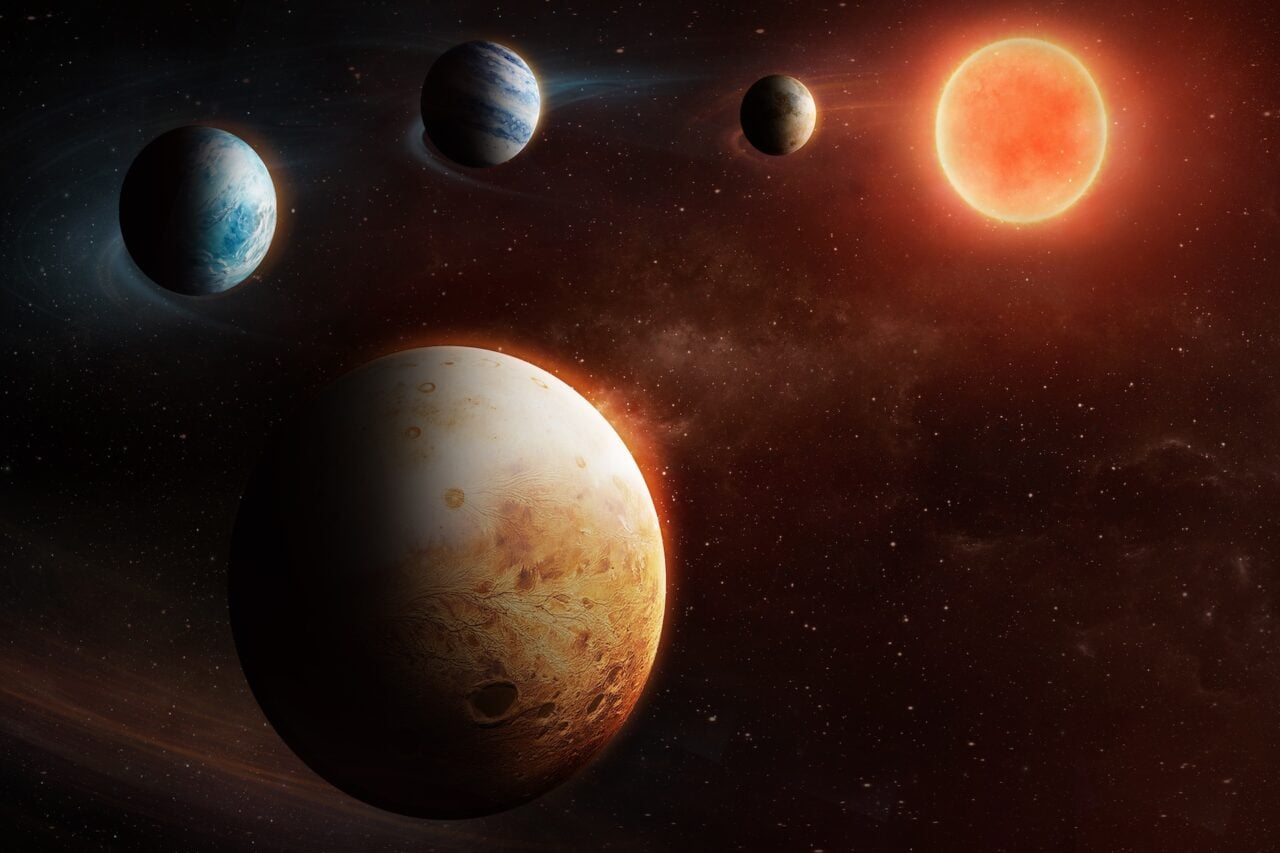
Astronomers have identified a peculiar star system, designated as LHS 1903, which challenges established theories of planet formation. The discovery reveals a unique arrangement where the outermost planet is rocky, unlike typical systems where rocky planets are found closer to their host stars. This unusual configuration raises significant questions regarding how planets develop and evolve in the cosmos.
The star LHS 1903 is a small red M-dwarf, characterized by its cooler and dimmer nature compared to our Sun. A team of researchers, led by Thomas Wilson, a physics professor at the University of Warwick, utilized observations from various space telescopes to identify three existing planets orbiting this star. During their analysis with the European Space Agency’s CHEOPS space telescope, the researchers discovered a fourth planet, which turned out to be rocky. This finding contradicts prevailing theories of planet formation, where gas giants typically occupy the outer regions of a star system.
Unraveling the Mystery of Planet Formation
The configuration of planets in LHS 1903 is particularly striking, with the order being rocky, gas, gas, and then rocky. This contradicts the established understanding that rocky planets are formed closer to their star, while gas giants emerge in cooler, outer regions where gas can accumulate. According to Wilson, “This strange disorder makes it a unique inside-out system. Rocky planets don’t usually form far away from their home star, on the outside of the gaseous worlds.”
The study emphasizes that the outermost rocky planet may have either lost its gaseous atmosphere or never managed to form one at all. Traditional planet formation theories suggest that the intense radiation from a star strips nearby planets of their gas, leading to a predominance of rocky bodies in inner orbits. The researchers proposed several scenarios to explain the anomalous configuration, including the possibility that planets may have swapped positions or that a significant asteroid impact could have stripped the rocky planet of its atmosphere. However, these hypotheses did not hold up under scrutiny.
Instead, the evidence suggested a different narrative: the planets in this system may not have formed simultaneously. In typical star systems, planets develop from protoplanetary discs of gas and dust, emerging at roughly the same time. In contrast, LHS 1903 may have produced its planets sequentially. Wilson noted, “By the time this final outer planet formed, the system may have already run out of gas, which is considered vital for planet formation. Yet here is a small, rocky world, defying expectations.”
A New Perspective on Exoplanet Systems
The findings from LHS 1903 could indicate a broader diversity in planet formation patterns across the universe. Isabel Rebollido, a research fellow at the European Space Agency, commented on the implications of this discovery, stating, “Historically, our planet formation theories are based on what we see and know about our solar system. As we are seeing more and more different exoplanet systems, we are starting to revisit these theories.”
This research not only contributes to our understanding of a unique star system but also challenges scientists to re-evaluate existing models of how planets are formed. As astronomers continue to explore the complexities of exoplanet systems, the case of LHS 1903 serves as a reminder of the vast diversity that exists in our universe, prompting further inquiry into the mechanisms of planetary formation and evolution.

Funko’s Price Target Increased to $4.00 as Analysts React

Humboldt Celebrates as ‘One Battle After Another’ Claims Best Picture

GSK Faces Backlash Over Asthma Inhaler Scrapping, Children Suffer

Adorable Sandhill Crane Colt Hugs Mom in The Villages

USA Unveils Star-Spangled Jerseys Ahead of March Friendlies

Newport Plans Colorful Lighting for Fourth Street Bridge

Sandia Scientists Honored for Innovative Career Journeys

Urgent: Charles M. Payment Passes Away at 78, Memorial Details Inside

NFL Free Agency: Key Moves and Player Signings in Week One

Researchers Launch $1.25M Project for Real-Time Hazard Monitoring in Hawaiʻi

Send It South Revives Culture and Community at The Momentary

UK Government Borrowing Hits £20.2 Billion in September Surge

Flipkart Republic Day Sale: iPhone 16 Plus Price Slashed by ₹23,900

Adecco SA Secures Mixed Ratings from Analysts Amid Earnings Update

Researchers Achieve Record 15.1 mA/cm² Hydrogen Production Efficiency

Globant Reveals Key Tech Forces Shaping Business in 2026

Inventor Achieves Breakthrough with 2 Billion FPS Laser Video

Dua Lipa Aces GCSE Spanish, Sparks Super Bowl Buzz with Fans
-
 Science8 months ago
Researchers Launch $1.25M Project for Real-Time Hazard Monitoring in Hawaiʻi
-
 Entertainment7 months ago
Send It South Revives Culture and Community at The Momentary
-
 World9 months ago
UK Government Borrowing Hits £20.2 Billion in September Surge
-
 Business6 months ago
Flipkart Republic Day Sale: iPhone 16 Plus Price Slashed by ₹23,900
-
 Sports7 months ago
Adecco SA Secures Mixed Ratings from Analysts Amid Earnings Update
-
 Top Stories5 months ago
Researchers Achieve Record 15.1 mA/cm² Hydrogen Production Efficiency
-
 Business8 months ago
Globant Reveals Key Tech Forces Shaping Business in 2026
-
 Science9 months ago
Inventor Achieves Breakthrough with 2 Billion FPS Laser Video
-
 Entertainment10 months ago
Dua Lipa Aces GCSE Spanish, Sparks Super Bowl Buzz with Fans
-

 Top Stories10 months ago
Charlie Sheen’s New Romance: ‘Glowing’ with Younger Partner
-

 Top Stories7 months ago
JSerra Names Hardy Nickerson as First Black Football Coach
-

 Health10 months ago
Community Unites for 7th Annual Into the Light Walk for Mental Health