
Science
China Celebrates 600th Long March Rocket Launch with New Satellites

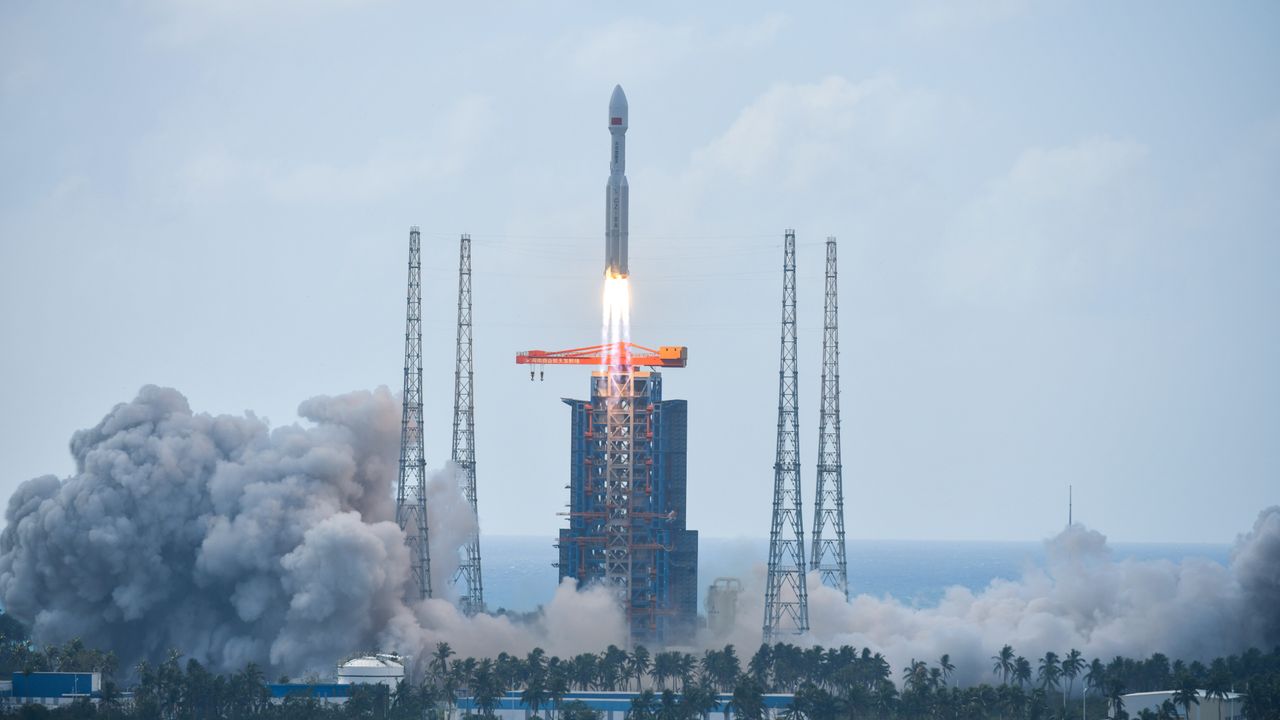
China marked a significant milestone on October 15, 2025, with the launch of its 600th Long March rocket. A Long March 8A took off from the Wenchang Space Launch Center on Hainan Island at 21:33 EDT (01:33 GMT on October 16 and 09:33 local time). This mission successfully deployed a batch of satellites for the Guowang broadband network, further expanding China’s efforts in satellite communications.
The Long March rocket family has a storied history, beginning with its first flight on April 24, 1970. That mission successfully placed the country’s first satellite, Dong Fang Hong 1, into orbit. Over the past 55 years, China has developed over 20 different types of Long March rockets, with 16 currently active, according to China Daily.
The pace of launches has increased dramatically in recent years. The initial 100 missions took 37 years, while the subsequent milestones were achieved in progressively shorter timeframes. The second 100 launches occurred in just 7.5 years; the next 100 were completed in just over four years. Notably, the most recent 100 launches took only one year and 10 months. Overall, the Long March fleet boasts an impressive success rate of approximately 97%.
While the Long March rocket family is a major player in space launches, it is not the most frequently flown. That title belongs to the Soviet/Russian Soyuz rocket line, which has completed over 1,700 missions since its debut in November 1966. Other notable rocket families that have reached the 600 mark include the Soviet Union’s Kosmos family and the American Atlas series. SpaceX is also approaching this milestone with its Falcon rockets, having conducted over 570 flights to date, including an impressive 130 Falcon 9 launches so far this year.
The Guowang network, translating to “national network,” is a developing broadband megaconstellation designed to operate in low Earth orbit (LEO). Managed by the state-run company China Satnet, the network aims to consist of about 13,000 satellites. The recent launch successfully deployed the 12th group of Guowang satellites, each batch typically comprising eight to ten spacecraft.
In addition to Guowang, another Chinese internet constellation known as Qianfan, or “Thousand Sails,” is in development and also aims for a similar number of satellites. Both networks are modeled after SpaceX’s Starlink megaconstellation, which currently operates more than 8,600 spacecraft and continues to expand rapidly. Approximately 70% of this year’s Falcon 9 launches have been dedicated to Starlink missions.
The successful launch of the 600th Long March rocket illustrates China’s growing capabilities in space technology and satellite communications. As the nation continues to advance its space initiatives, the implications for global broadband access and satellite-based services are profound, positioning China as a significant player in the international space arena.

Funko’s Price Target Increased to $4.00 as Analysts React

Humboldt Celebrates as ‘One Battle After Another’ Claims Best Picture

GSK Faces Backlash Over Asthma Inhaler Scrapping, Children Suffer

Adorable Sandhill Crane Colt Hugs Mom in The Villages

USA Unveils Star-Spangled Jerseys Ahead of March Friendlies

Newport Plans Colorful Lighting for Fourth Street Bridge

Sandia Scientists Honored for Innovative Career Journeys

Urgent: Charles M. Payment Passes Away at 78, Memorial Details Inside

NFL Free Agency: Key Moves and Player Signings in Week One

Researchers Launch $1.25M Project for Real-Time Hazard Monitoring in Hawaiʻi

Send It South Revives Culture and Community at The Momentary

UK Government Borrowing Hits £20.2 Billion in September Surge

Flipkart Republic Day Sale: iPhone 16 Plus Price Slashed by ₹23,900

Adecco SA Secures Mixed Ratings from Analysts Amid Earnings Update

Researchers Achieve Record 15.1 mA/cm² Hydrogen Production Efficiency

Globant Reveals Key Tech Forces Shaping Business in 2026

Inventor Achieves Breakthrough with 2 Billion FPS Laser Video

Dua Lipa Aces GCSE Spanish, Sparks Super Bowl Buzz with Fans
-
 Science8 months ago
Researchers Launch $1.25M Project for Real-Time Hazard Monitoring in Hawaiʻi
-
 Entertainment7 months ago
Send It South Revives Culture and Community at The Momentary
-
 World9 months ago
UK Government Borrowing Hits £20.2 Billion in September Surge
-
 Business6 months ago
Flipkart Republic Day Sale: iPhone 16 Plus Price Slashed by ₹23,900
-
 Sports7 months ago
Adecco SA Secures Mixed Ratings from Analysts Amid Earnings Update
-
 Top Stories5 months ago
Researchers Achieve Record 15.1 mA/cm² Hydrogen Production Efficiency
-
 Business8 months ago
Globant Reveals Key Tech Forces Shaping Business in 2026
-
 Science9 months ago
Inventor Achieves Breakthrough with 2 Billion FPS Laser Video
-
 Entertainment10 months ago
Dua Lipa Aces GCSE Spanish, Sparks Super Bowl Buzz with Fans
-

 Top Stories10 months ago
Charlie Sheen’s New Romance: ‘Glowing’ with Younger Partner
-

 Top Stories7 months ago
JSerra Names Hardy Nickerson as First Black Football Coach
-

 Entertainment10 months ago
Olivia Plath Opens Up About Her Marriage Struggles and Divorce