
Science
Interstellar Comet 3I/ATLAS Shows Remarkable Tail Growth

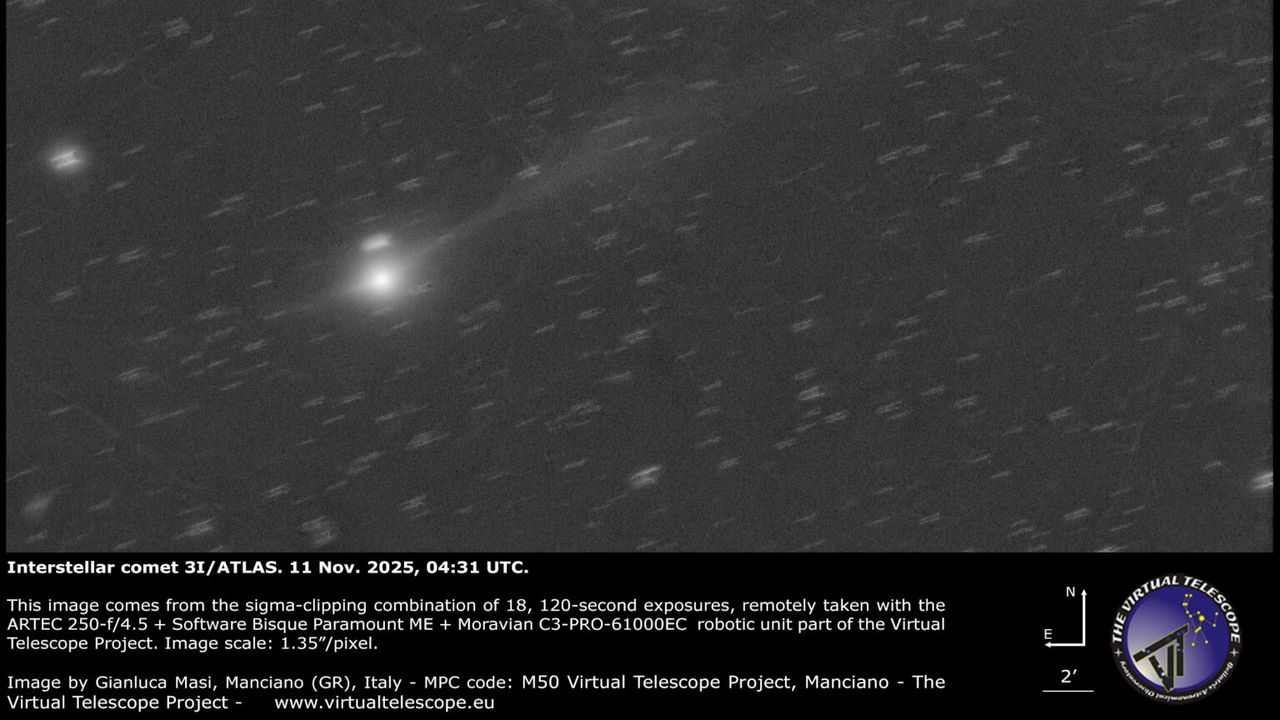
A recent image of interstellar comet 3I/ATLAS (C/2025 N1 ATLAS) reveals significant growth in its ion tail, indicating heightened activity as it traverses the inner solar system. Captured by the Virtual Telescope Project at 23:31 EDT on November 10, 2023 (04:31 GMT on November 11), the image demonstrates the comet’s tail has become longer and more structured. This visual data was compiled from 18 separate 120-second exposures taken by robotic telescopes based in Manciano, Italy.
The image showcases a clearly defined ion tail, despite the challenge posed by a bright 61% moon located approximately 70 degrees away. Gianluca Masi, the founder of the Virtual Telescope Project, noted the favorable weather conditions allowed for this detailed observation. “We imaged the interstellar comet 3I/ATLAS again, recording a much more developed ion tail,” Masi stated in a recent post. He emphasized that the tail’s clarity indicates increasing activity.
Understanding the Ion Tail
An ion tail forms when the sun’s ultraviolet radiation interacts with gas molecules released by the comet, stripping away electrons and converting them into charged ions. These ions are propelled away by the solar wind, creating a long, bluish tail that consistently points away from the sun, regardless of the comet’s trajectory. In contrast, the dust tail is typically yellowish-white and follows the comet’s orbital path.
In the newly captured image, the comet’s bright core is encircled by a compact coma, with the ion tail extending roughly 0.7 degrees across the sky. A faint anti-tail, resulting from the observer’s viewpoint as dust trails along the comet’s orbit, is also visible. The enhanced activity observed in this image suggests that 3I/ATLAS is releasing gas and dust more vigorously as it comes under the influence of solar heating.
Significance of 3I/ATLAS
Discovered in July 2023, 3I/ATLAS is only the third confirmed interstellar object detected, following 1I/’Oumuamua in 2017 and 2I/Borisov in 2019. Unlike its predecessors, this comet’s brightness allows for detailed study using ground-based telescopes, presenting a unique opportunity for astronomers to observe its behavior under solar influence.
The remarkable length and brightness of the ion tail suggest an increase in the sublimation of volatile materials, likely including carbon dioxide and dust. Early data indicates that 3I/ATLAS may contain a significant amount of carbon dioxide ice, providing potential insights into the conditions of the distant planetary system from which it originated. This could enhance our understanding of how comets evolve beyond our solar neighborhood.
The Virtual Telescope Project will continue to monitor 3I/ATLAS as it progresses through the inner solar system, offering valuable data for ongoing research into interstellar objects. For those interested, past images of the comet can be accessed, showcasing its journey since its detection earlier this year.

Funko’s Price Target Increased to $4.00 as Analysts React

Humboldt Celebrates as ‘One Battle After Another’ Claims Best Picture

GSK Faces Backlash Over Asthma Inhaler Scrapping, Children Suffer

Adorable Sandhill Crane Colt Hugs Mom in The Villages

USA Unveils Star-Spangled Jerseys Ahead of March Friendlies

Newport Plans Colorful Lighting for Fourth Street Bridge

Sandia Scientists Honored for Innovative Career Journeys

Urgent: Charles M. Payment Passes Away at 78, Memorial Details Inside

NFL Free Agency: Key Moves and Player Signings in Week One

Researchers Launch $1.25M Project for Real-Time Hazard Monitoring in Hawaiʻi

Send It South Revives Culture and Community at The Momentary

UK Government Borrowing Hits £20.2 Billion in September Surge

Flipkart Republic Day Sale: iPhone 16 Plus Price Slashed by ₹23,900

Adecco SA Secures Mixed Ratings from Analysts Amid Earnings Update

Researchers Achieve Record 15.1 mA/cm² Hydrogen Production Efficiency

Globant Reveals Key Tech Forces Shaping Business in 2026

Inventor Achieves Breakthrough with 2 Billion FPS Laser Video

Dua Lipa Aces GCSE Spanish, Sparks Super Bowl Buzz with Fans
-
 Science8 months ago
Researchers Launch $1.25M Project for Real-Time Hazard Monitoring in Hawaiʻi
-
 Entertainment7 months ago
Send It South Revives Culture and Community at The Momentary
-
 World9 months ago
UK Government Borrowing Hits £20.2 Billion in September Surge
-
 Business6 months ago
Flipkart Republic Day Sale: iPhone 16 Plus Price Slashed by ₹23,900
-
 Sports7 months ago
Adecco SA Secures Mixed Ratings from Analysts Amid Earnings Update
-
 Top Stories5 months ago
Researchers Achieve Record 15.1 mA/cm² Hydrogen Production Efficiency
-
 Business8 months ago
Globant Reveals Key Tech Forces Shaping Business in 2026
-
 Science9 months ago
Inventor Achieves Breakthrough with 2 Billion FPS Laser Video
-
 Entertainment10 months ago
Dua Lipa Aces GCSE Spanish, Sparks Super Bowl Buzz with Fans
-

 Top Stories10 months ago
Charlie Sheen’s New Romance: ‘Glowing’ with Younger Partner
-

 Top Stories7 months ago
JSerra Names Hardy Nickerson as First Black Football Coach
-

 Health10 months ago
Community Unites for 7th Annual Into the Light Walk for Mental Health