
Science
NASA Launches Apollo-Saturn IB Rocket AS-201 from Cape Kennedy

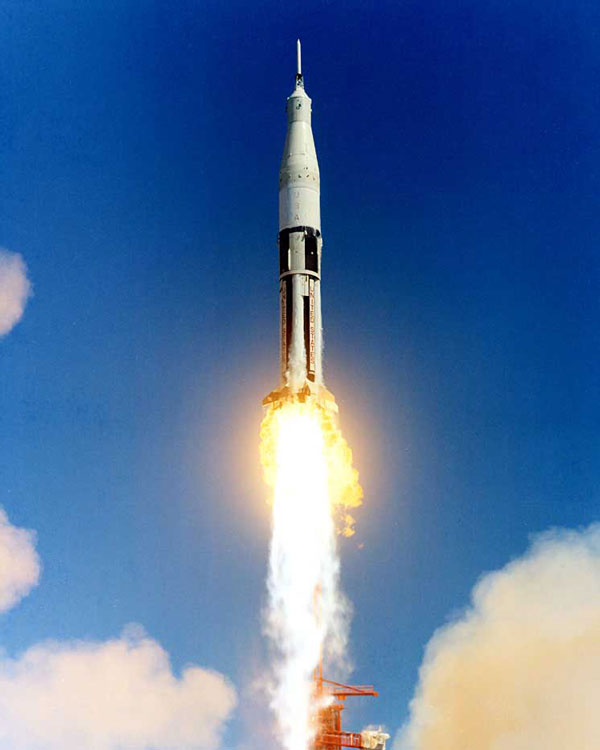
On February 26, 1966, NASA achieved a significant milestone in space exploration with the launch of the Apollo-Saturn IB rocket, designated AS-201. The uncrewed mission took off from Cape Kennedy, now known as Cape Canaveral, at 11:12 a.m. EST. This event marked the inaugural flight of the Saturn IB, a crucial step in the development of the hardware that would ultimately carry astronauts to the Moon.
Significance of the Saturn IB Rocket
The Saturn IB was designed to serve as a bridge between earlier rockets and the more powerful Saturn V, which would later enable human landing missions on the lunar surface. With its enhanced capability to transport heavier payloads into orbit, the Saturn IB was essential for testing the Apollo spacecraft under realistic flight conditions.
During the 37-minute suborbital mission, engineers conducted rigorous evaluations of the Apollo Command and Service Modules. One of the primary objectives was to assess the spacecraft’s heat shield during high-speed reentry, a critical factor for future missions returning from the Moon. After reaching space, the Apollo capsule reentered Earth’s atmosphere and successfully splashed down in the Atlantic Ocean.
The successful recovery of AS-201 demonstrated that the heat shield could withstand the extreme temperatures encountered during reentry, an essential capability for upcoming missions. This achievement confirmed that the propulsion, guidance, and structural systems of the Apollo spacecraft were operating as intended.
Impact on Future Space Missions
The success of the AS-201 mission laid the groundwork for more complex tests and paved the way for crewed Apollo flights that would define the era of lunar exploration. In the years following this launch, NASA would continue to build on the findings from AS-201, ultimately leading to the historic Apollo 11 mission in 1969, when humans first set foot on the Moon.
Sixty years after the launch of AS-201, Florida’s Space Coast remains a hub of space activity. As of February 2026, Space Coast Daily continues to report on ongoing operations at Cape Canaveral, including the recent launch of the 33rd SpaceX resupply mission. This evolution from the Saturn IB to modern commercial launch vehicles highlights the significant advancements in the aerospace industry, while also honoring the legacy established by the engineers and visionaries behind the Apollo program.
On this day in history, February 26, 1966, NASA proved the resilience of the hardware designed to transport humans to the Moon, setting the stage for one of humanity’s greatest achievements in space exploration. The successful launch of AS-201 not only marked a pivotal moment in the space race but also illustrated the importance of rigorous testing and innovation in the quest to explore beyond our planet.

Funko’s Price Target Increased to $4.00 as Analysts React

Humboldt Celebrates as ‘One Battle After Another’ Claims Best Picture

GSK Faces Backlash Over Asthma Inhaler Scrapping, Children Suffer

Adorable Sandhill Crane Colt Hugs Mom in The Villages

USA Unveils Star-Spangled Jerseys Ahead of March Friendlies

Newport Plans Colorful Lighting for Fourth Street Bridge

Sandia Scientists Honored for Innovative Career Journeys

Urgent: Charles M. Payment Passes Away at 78, Memorial Details Inside

NFL Free Agency: Key Moves and Player Signings in Week One

Researchers Launch $1.25M Project for Real-Time Hazard Monitoring in Hawaiʻi

Send It South Revives Culture and Community at The Momentary

UK Government Borrowing Hits £20.2 Billion in September Surge

Flipkart Republic Day Sale: iPhone 16 Plus Price Slashed by ₹23,900

Adecco SA Secures Mixed Ratings from Analysts Amid Earnings Update

Researchers Achieve Record 15.1 mA/cm² Hydrogen Production Efficiency

Globant Reveals Key Tech Forces Shaping Business in 2026

Inventor Achieves Breakthrough with 2 Billion FPS Laser Video

Dua Lipa Aces GCSE Spanish, Sparks Super Bowl Buzz with Fans
-
 Science8 months ago
Researchers Launch $1.25M Project for Real-Time Hazard Monitoring in Hawaiʻi
-
 Entertainment7 months ago
Send It South Revives Culture and Community at The Momentary
-
 World9 months ago
UK Government Borrowing Hits £20.2 Billion in September Surge
-
 Business6 months ago
Flipkart Republic Day Sale: iPhone 16 Plus Price Slashed by ₹23,900
-
 Sports7 months ago
Adecco SA Secures Mixed Ratings from Analysts Amid Earnings Update
-
 Top Stories5 months ago
Researchers Achieve Record 15.1 mA/cm² Hydrogen Production Efficiency
-
 Business8 months ago
Globant Reveals Key Tech Forces Shaping Business in 2026
-
 Science9 months ago
Inventor Achieves Breakthrough with 2 Billion FPS Laser Video
-
 Entertainment10 months ago
Dua Lipa Aces GCSE Spanish, Sparks Super Bowl Buzz with Fans
-

 Top Stories10 months ago
Charlie Sheen’s New Romance: ‘Glowing’ with Younger Partner
-

 Top Stories7 months ago
JSerra Names Hardy Nickerson as First Black Football Coach
-

 Health10 months ago
Community Unites for 7th Annual Into the Light Walk for Mental Health