
Science
Nebraska University Secures $2.5 Million for Quantum Research

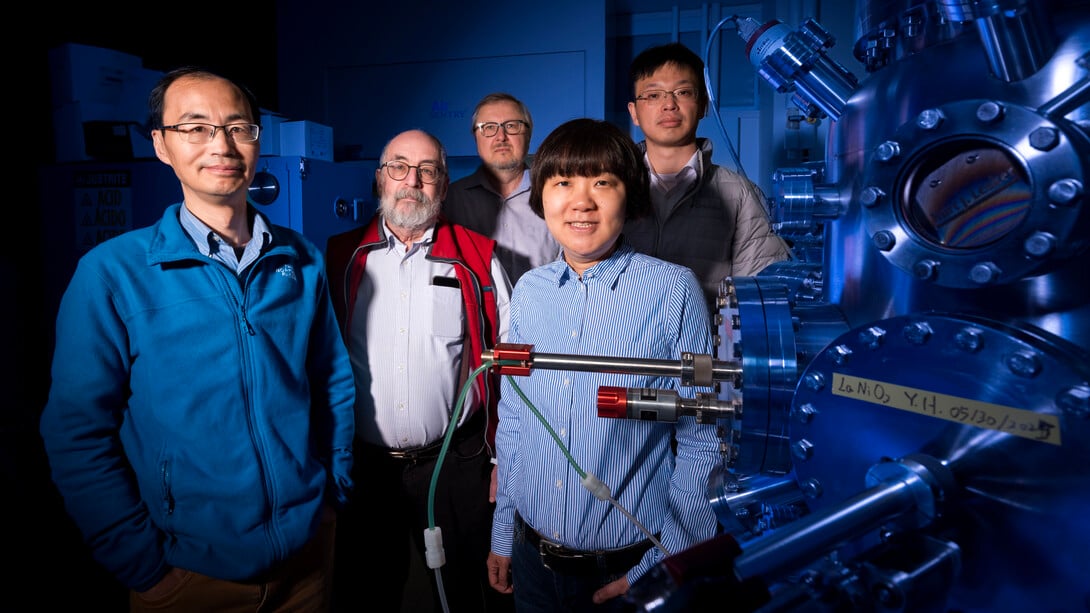
The University of Nebraska–Lincoln has been awarded a substantial $2.5 million grant to advance research in quantum materials, specifically focusing on the application of ferroelectric oxides. This funding, provided by the Department of Energy through its Established Program to Stimulate Competitive Research (EPSCoR), is aimed at developing innovative methods to explore emergent quantum phases and enhance the design of energy-efficient electronic devices.
Advancing Quantum Research
The research will be led by Xia Hong, a professor of physics and astronomy, alongside a seven-member team. Their goal is to utilize ferroelectric oxides to manipulate oxide and van der Waals materials. This approach aims to achieve remarkable transitions, such as switching materials from a metal to an insulator or altering their magnetic properties. “The overarching goal is to use nanoscale control of ferroelectricity to induce a new state of matter,” said Hong. She emphasized that this research could pave the way for more compact and energy-efficient devices.
This two-year grant marks the third significant funding boost for the university’s Emergent Quantum Materials and Technologies (EQUATE) Center in recent months. Previously, a $1.8 million grant from the National Science Foundation was awarded to a team led by Christian Binek, who is also the EQUATE director. Another international collaboration, spearheaded by Evgeny Tsymbal, received $2 million to innovate in the field of material design.
Fostering Workforce Development
Hong, who is the principal investigator for the DOE EPSCoR award, highlighted that workforce development is a critical aspect of this project, titled “Emergent Interface Phenomena Enabled by Ferroelectric Oxide Thin Films and Membranes.” The initiative includes a partnership with the South Dakota School of Mines and Technology and is designed to be renewable for up to four more years.
The EPSCoR program emphasizes developing infrastructure in Nebraska and South Dakota, which will support three early-career scientists: Zuocheng Zhang from the University of Nebraska–Lincoln, and Tula Paudel and Alexey Lipatov from the South Dakota School of Mines. Each of the seven research team members will also involve graduate and postdoctoral researchers, alongside undergraduate students, in their work.
“The idea with EPSCoR is you’re not just looking into the research, you’re looking into the infrastructure and human resource development,” Hong explained.
The project has three main thrusts. The first focuses on the interface between ferroelectric oxides and strongly correlated oxides, aiming to control quantum phase transitions reversibly. The research team seeks to develop a fully switchable, low-voltage control that could be applicable for binary logic and memory devices, moving away from traditional methods that are often destructive.
The second thrust explores multiferroic systems that exhibit both ferroelectricity and magnetism. By employing various doping methods, the team aims to convert ferroelectric insulators into polar metals, which could enable low-energy data storage through the manipulation of magnetic states.
The third thrust aims to construct superlattices of ferroelectric domains to engineer novel electronic and optical properties in two-dimensional van der Waals materials. By adjusting the rotation angle between two oxide layers using stacking techniques, the team hopes to create new Moiré patterns that induce emergent electronic and magnetic states.
If the research proves successful, it could lead to advancements in smartphones and a plethora of electronic devices. Emerging materials have the potential to revolutionize operating systems, enhancing performance while minimizing energy consumption.
Reflecting on her decision to join the University of Nebraska–Lincoln 15 years ago, Hong noted that the institution’s robust infrastructure and sophisticated instrumentation played a significant role. “That’s the beauty of fundamental science — even if the impact is not immediately apparent, we are driven by curiosity and the allure of nature,” she said.

Funko’s Price Target Increased to $4.00 as Analysts React

Humboldt Celebrates as ‘One Battle After Another’ Claims Best Picture

GSK Faces Backlash Over Asthma Inhaler Scrapping, Children Suffer

Adorable Sandhill Crane Colt Hugs Mom in The Villages

USA Unveils Star-Spangled Jerseys Ahead of March Friendlies

Newport Plans Colorful Lighting for Fourth Street Bridge

Sandia Scientists Honored for Innovative Career Journeys

Urgent: Charles M. Payment Passes Away at 78, Memorial Details Inside

NFL Free Agency: Key Moves and Player Signings in Week One

Researchers Launch $1.25M Project for Real-Time Hazard Monitoring in Hawaiʻi

Send It South Revives Culture and Community at The Momentary

UK Government Borrowing Hits £20.2 Billion in September Surge

Flipkart Republic Day Sale: iPhone 16 Plus Price Slashed by ₹23,900

Adecco SA Secures Mixed Ratings from Analysts Amid Earnings Update

Researchers Achieve Record 15.1 mA/cm² Hydrogen Production Efficiency

Globant Reveals Key Tech Forces Shaping Business in 2026

Inventor Achieves Breakthrough with 2 Billion FPS Laser Video

Dua Lipa Aces GCSE Spanish, Sparks Super Bowl Buzz with Fans
-
 Science8 months ago
Researchers Launch $1.25M Project for Real-Time Hazard Monitoring in Hawaiʻi
-
 Entertainment7 months ago
Send It South Revives Culture and Community at The Momentary
-
 World9 months ago
UK Government Borrowing Hits £20.2 Billion in September Surge
-
 Business6 months ago
Flipkart Republic Day Sale: iPhone 16 Plus Price Slashed by ₹23,900
-
 Sports8 months ago
Adecco SA Secures Mixed Ratings from Analysts Amid Earnings Update
-
 Top Stories5 months ago
Researchers Achieve Record 15.1 mA/cm² Hydrogen Production Efficiency
-
 Business8 months ago
Globant Reveals Key Tech Forces Shaping Business in 2026
-
 Science9 months ago
Inventor Achieves Breakthrough with 2 Billion FPS Laser Video
-
 Entertainment10 months ago
Dua Lipa Aces GCSE Spanish, Sparks Super Bowl Buzz with Fans
-

 Top Stories10 months ago
Charlie Sheen’s New Romance: ‘Glowing’ with Younger Partner
-

 Top Stories7 months ago
JSerra Names Hardy Nickerson as First Black Football Coach
-

 Health10 months ago
Community Unites for 7th Annual Into the Light Walk for Mental Health