
Science
Researchers Discover Microbes Change Swimming Tactics for Light

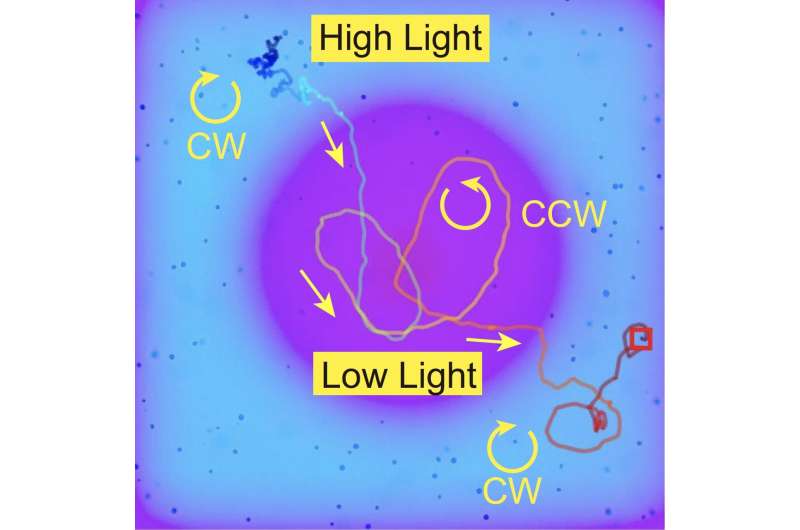
Research conducted by a team from the University of Hong Kong and the University of Exeter has revealed that a species of self-propelling microbes, specifically Chlamydomonas reinhardtii, can alter their swimming behavior based on light availability. The findings, published on March 2, 2026, in Physical Review Letters, highlight a unique adaptation that optimizes the microbes’ photosynthesis process.
Microbes like Chlamydomonas reinhardtii propel themselves using hair-like appendages known as flagella. Their swimming strategies are diverse; while some bacteria utilize a “run-and-tumble” technique, others navigate by modifying their swimming paths in response to environmental cues. Despite extensive research on microbial locomotion, the specific biophysical triggers that prompt these changes have remained largely elusive.
In 2021, researchers Kirsty Wan and Dario Cortese from the University of Exeter made significant strides in understanding the swimming mechanics of Chlamydomonas reinhardtii. By observing individual algal cells in three-dimensional space, they discovered that these microorganisms follow corkscrew trajectories through their fluid environment. The direction of these helical paths can be adjusted by changing the frequency, amplitude, and synchronization of their flagella, particularly when influenced by light.
Building on this foundational work, Zhao Wang and his team conducted a more detailed analysis of the swimming dynamics of these algae. Utilizing high-speed imaging techniques, they examined the independent movements of each flagellum under varying light conditions. Their observations revealed that at lower light intensities, the cells swim in counterclockwise circles, with one flagellum dominating propulsion due to its proximity to the cell’s light-sensing structure, known as the eyespot.
As light intensity increases beyond a certain threshold, the behavior shifts dramatically. The balance between the two flagella becomes equal, and the phase relationship of their beats changes, redirecting the cell’s motion toward the light source. This dynamic adjustment not only enhances light absorption but also aids in the optimization of photosynthesis.
The researchers propose that this remarkable ability to alter swimming patterns has evolved in Chlamydomonas reinhardtii to better regulate exposure to light, steering away from unfavorable conditions. Such insights could have broader implications beyond microbial biology.
The findings may inform the development of advanced microscopic swimming robots capable of navigating confined spaces, where traditional methods fall short. These robots could be engineered to perform intricate tasks, including targeted drug delivery within the human body, leveraging the same precise control over trajectory demonstrated by these microscopic organisms.
This research not only enhances our understanding of microbial motion but also opens pathways for innovative applications in technology and medicine, showcasing the potential of nature-inspired design in engineering.
For further details, refer to the study titled “Light-Dependent Switching of Circling Handedness in Microswimmer Navigation” by Zhao Wang et al, available in Physical Review Letters.

Funko’s Price Target Increased to $4.00 as Analysts React

Humboldt Celebrates as ‘One Battle After Another’ Claims Best Picture

GSK Faces Backlash Over Asthma Inhaler Scrapping, Children Suffer

Adorable Sandhill Crane Colt Hugs Mom in The Villages

USA Unveils Star-Spangled Jerseys Ahead of March Friendlies

Newport Plans Colorful Lighting for Fourth Street Bridge

Sandia Scientists Honored for Innovative Career Journeys

Urgent: Charles M. Payment Passes Away at 78, Memorial Details Inside

NFL Free Agency: Key Moves and Player Signings in Week One

Researchers Launch $1.25M Project for Real-Time Hazard Monitoring in Hawaiʻi

Send It South Revives Culture and Community at The Momentary

UK Government Borrowing Hits £20.2 Billion in September Surge

Flipkart Republic Day Sale: iPhone 16 Plus Price Slashed by ₹23,900

Adecco SA Secures Mixed Ratings from Analysts Amid Earnings Update

Researchers Achieve Record 15.1 mA/cm² Hydrogen Production Efficiency

Globant Reveals Key Tech Forces Shaping Business in 2026

Inventor Achieves Breakthrough with 2 Billion FPS Laser Video

Dua Lipa Aces GCSE Spanish, Sparks Super Bowl Buzz with Fans
-
 Science8 months ago
Researchers Launch $1.25M Project for Real-Time Hazard Monitoring in Hawaiʻi
-
 Entertainment7 months ago
Send It South Revives Culture and Community at The Momentary
-
 World9 months ago
UK Government Borrowing Hits £20.2 Billion in September Surge
-
 Business6 months ago
Flipkart Republic Day Sale: iPhone 16 Plus Price Slashed by ₹23,900
-
 Sports7 months ago
Adecco SA Secures Mixed Ratings from Analysts Amid Earnings Update
-
 Top Stories5 months ago
Researchers Achieve Record 15.1 mA/cm² Hydrogen Production Efficiency
-
 Business8 months ago
Globant Reveals Key Tech Forces Shaping Business in 2026
-
 Science9 months ago
Inventor Achieves Breakthrough with 2 Billion FPS Laser Video
-
 Entertainment10 months ago
Dua Lipa Aces GCSE Spanish, Sparks Super Bowl Buzz with Fans
-

 Top Stories10 months ago
Charlie Sheen’s New Romance: ‘Glowing’ with Younger Partner
-

 Top Stories7 months ago
JSerra Names Hardy Nickerson as First Black Football Coach
-

 Health10 months ago
Community Unites for 7th Annual Into the Light Walk for Mental Health