
Science
Researchers Use X-Rays to Uncover World’s Oldest Star Map

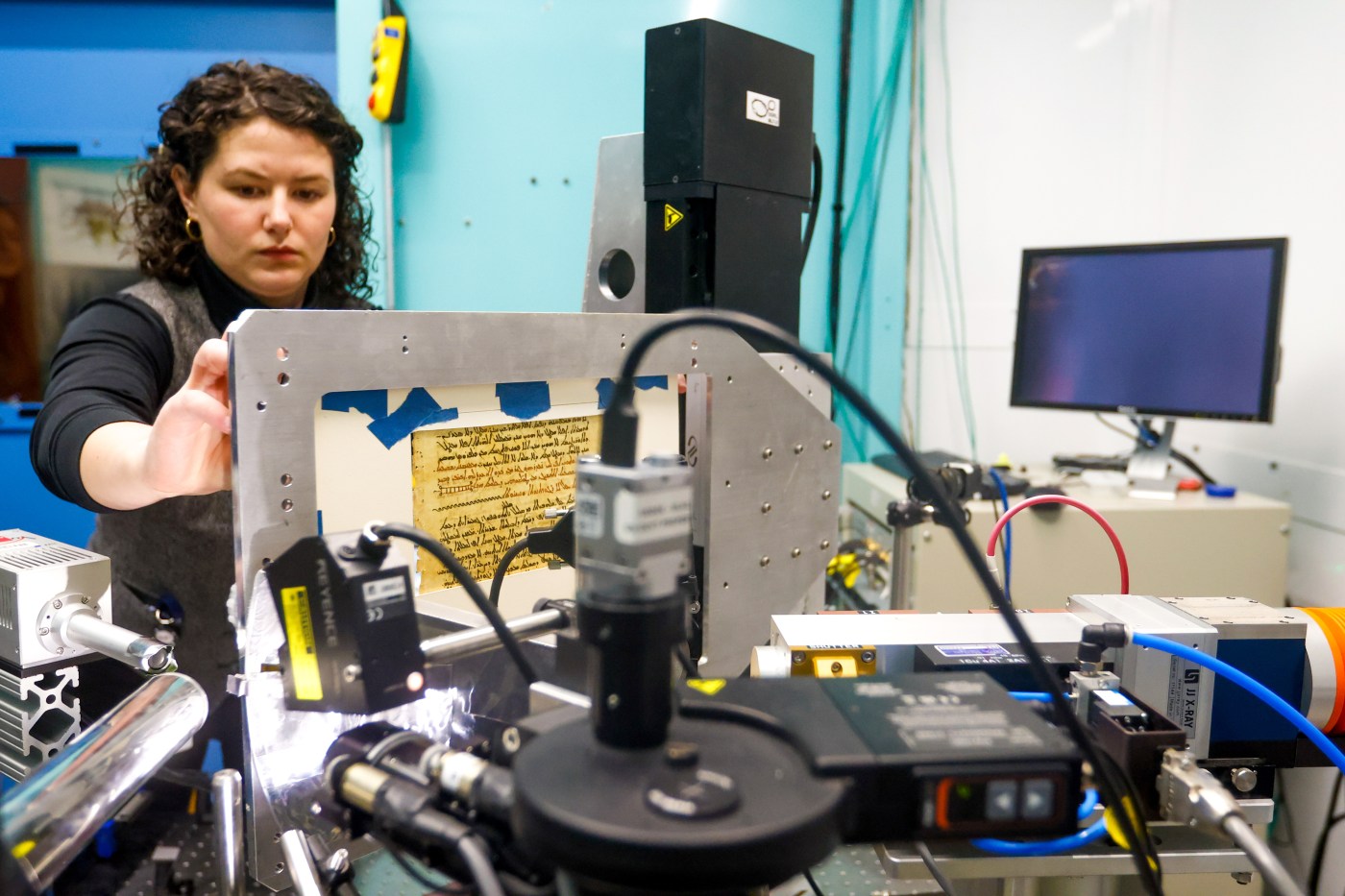
At the SLAC National Accelerator Laboratory in Menlo Park, California, researchers are utilizing advanced X-ray technology to reveal what may be the world’s oldest star map. On Wednesday morning, scientists directed a powerful X-ray machine at parchment pages from a medieval manuscript, aiming to uncover traces of the celestial catalog originally created more than 2,100 years ago by the Greek astronomer Hipparchus.
This ancient catalogue, which is known primarily from references in historical texts by figures such as Pliny the Elder, is believed to have documented over 800 celestial bodies along with their brightness and positions in the night sky. Although the original document has never been located, recent advancements in imaging technology have revealed parts of what is thought to be a high-quality copy of Hipparchus’s star map. This copy was likely inscribed around the 6th Century but later overwritten with Christian texts.
Lead scholar Victor Gysembergh from the French National Centre for Scientific Research expressed his excitement as he observed ancient Greek text emerge on a computer screen during the X-ray process. “We just have line after line of text showing up. I’m hoping to see the first star coordinates pop up. We expect this to be a real game-changer,” he stated. Gysembergh believes that this discovery could significantly enhance our understanding of the origins of astronomy.
The manuscript, known as the Codex Climaci Rescriptus, was discovered in the Sinai Desert at St. Catherine’s Monastery, where it had been overwritten by monks. The parchment, made from goat or sheep skin, was a valuable commodity in the medieval era. In 2012, while working on a summer project at Cambridge University, an undergraduate student identified a faint passage in ancient Greek related to astronomy among the 200 pages of the Christian manuscript.
Further research revealed more astronomical figures, leading scientists to compare the star coordinates with historical records. This analysis suggested that the map was created during Hipparchus’s lifetime in the second century B.C., based on shifts in Earth’s rotational axis. References by later astronomers, including Ptolemy, further solidified the map’s connection to Hipparchus’s pioneering work.
The current project employs X-ray beams from SLAC’s synchrotron particle accelerator, the leading high-energy X-ray facility in the western United States. Researchers are focusing on one page at a time, utilizing a beam many times more powerful than medical X-rays to detect minute traces of chemicals from the erased ink. According to Minhal Gardezi, a physics researcher at the University of Wisconsin and part of the Hipparchus team, some pages contain up to six layers of ink due to repeated overwriting.
The ink used for the star catalog was derived from tannin-rich oak galls, natural growths found on oak trees. By distinguishing the chemical signatures of the monks’ ink from that of Hipparchus’s text, the researchers aim to reveal the lost words through advanced image processing techniques.
As the X-ray machine continued its work, Gysembergh noted the appearance of the constellation Aquarius. “We have the word for Aquarius, we have the word for bright, so he’s talking about a bright star within Aquarius,” he explained. The anticipation among the research team is palpable, as they hope this project will yield crucial insights into early astronomical practices.
SLAC National Accelerator Laboratory has emerged as a leading center for historical document analysis using X-rays. In 2022, researchers applied similar techniques to pages from the Gutenberg Bible and ancient Confucian texts, seeking to understand the origins of the printing press. A paper detailing the findings from that research is set to be published soon.
As the project progresses, the scientific community watches closely to see how the rediscovery of Hipparchus’s star map may reshape our understanding of ancient astronomy and its influence on the development of the field.

Funko’s Price Target Increased to $4.00 as Analysts React

Humboldt Celebrates as ‘One Battle After Another’ Claims Best Picture

GSK Faces Backlash Over Asthma Inhaler Scrapping, Children Suffer

Adorable Sandhill Crane Colt Hugs Mom in The Villages

USA Unveils Star-Spangled Jerseys Ahead of March Friendlies

Newport Plans Colorful Lighting for Fourth Street Bridge

Sandia Scientists Honored for Innovative Career Journeys

Urgent: Charles M. Payment Passes Away at 78, Memorial Details Inside

NFL Free Agency: Key Moves and Player Signings in Week One

Researchers Launch $1.25M Project for Real-Time Hazard Monitoring in Hawaiʻi

Send It South Revives Culture and Community at The Momentary

UK Government Borrowing Hits £20.2 Billion in September Surge

Flipkart Republic Day Sale: iPhone 16 Plus Price Slashed by ₹23,900

Adecco SA Secures Mixed Ratings from Analysts Amid Earnings Update

Researchers Achieve Record 15.1 mA/cm² Hydrogen Production Efficiency

Globant Reveals Key Tech Forces Shaping Business in 2026

Inventor Achieves Breakthrough with 2 Billion FPS Laser Video

Dua Lipa Aces GCSE Spanish, Sparks Super Bowl Buzz with Fans
-
 Science8 months ago
Researchers Launch $1.25M Project for Real-Time Hazard Monitoring in Hawaiʻi
-
 Entertainment7 months ago
Send It South Revives Culture and Community at The Momentary
-
 World9 months ago
UK Government Borrowing Hits £20.2 Billion in September Surge
-
 Business6 months ago
Flipkart Republic Day Sale: iPhone 16 Plus Price Slashed by ₹23,900
-
 Sports8 months ago
Adecco SA Secures Mixed Ratings from Analysts Amid Earnings Update
-
 Top Stories5 months ago
Researchers Achieve Record 15.1 mA/cm² Hydrogen Production Efficiency
-
 Business8 months ago
Globant Reveals Key Tech Forces Shaping Business in 2026
-
 Science9 months ago
Inventor Achieves Breakthrough with 2 Billion FPS Laser Video
-
 Entertainment10 months ago
Dua Lipa Aces GCSE Spanish, Sparks Super Bowl Buzz with Fans
-

 Top Stories10 months ago
Charlie Sheen’s New Romance: ‘Glowing’ with Younger Partner
-

 Top Stories7 months ago
JSerra Names Hardy Nickerson as First Black Football Coach
-

 Health10 months ago
Community Unites for 7th Annual Into the Light Walk for Mental Health