
Science
Stephen Hawking’s 1974 Paper Revolutionizes Black Hole Theory

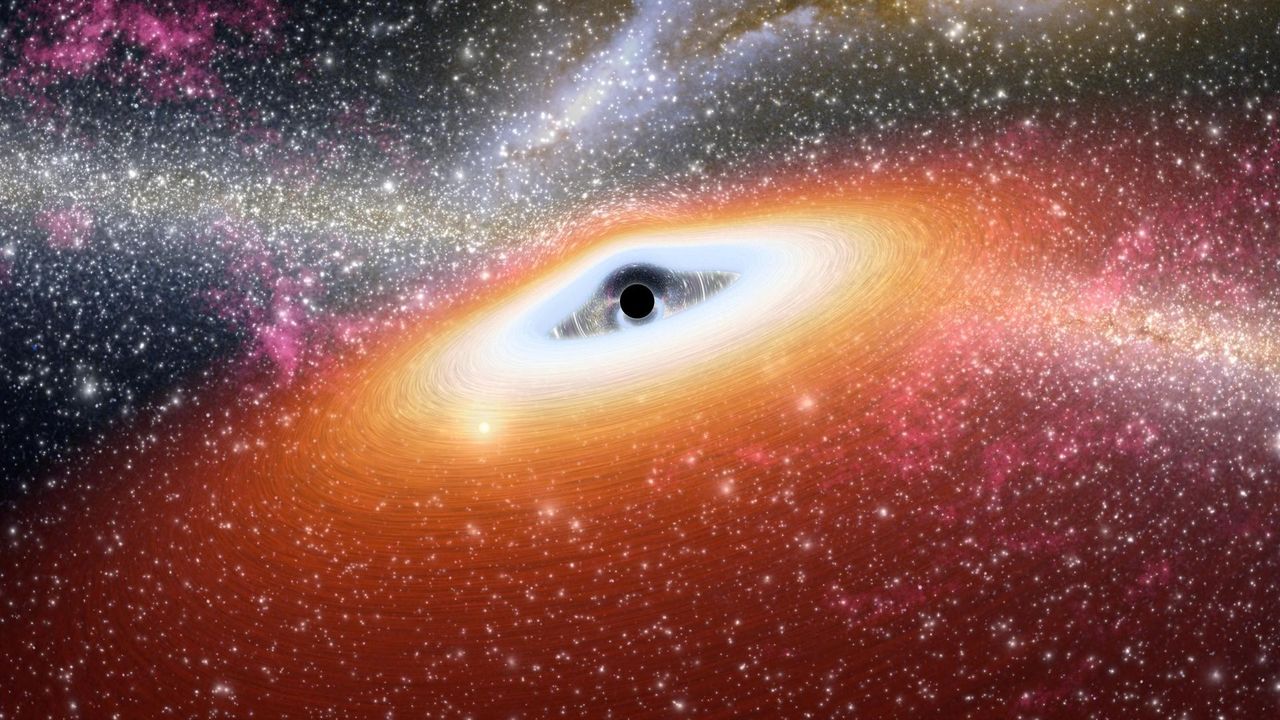
In a groundbreaking moment for theoretical physics, Stephen Hawking published a brief yet transformative paper on March 1, 1974, in the journal Nature. This work fundamentally altered our understanding of black holes, challenging long-held beliefs about their nature and behavior.
Before Hawking’s contribution, black holes were largely viewed through the lens of Einstein’s theory of relativity, which posited that their immense gravitational pull prevented anything, including light, from escaping. Consequently, it was believed that black holes could only grow larger over time, consuming surrounding matter and merging with other black holes.
Hawking’s work emerged from his exploration of how quantum mechanics interacts with black holes. Building on the insights of theoretical physicist Jacob Bekenstein, he combined general relativity, thermodynamics, and quantum physics to propose a revolutionary idea: black holes emit tiny amounts of heat, now known as Hawking radiation.
This radiation occurs due to the creation of pairs of “virtual” particles that spontaneously form and annihilate in the vacuum of space. In some instances, one particle falls into the black hole while the other escapes, resulting in a loss of energy that causes the black hole to gradually shrink. Hawking noted in his paper that although this evaporation process would take longer than the current age of the universe for larger black holes, smaller primordial black holes—believed to have formed during the universe’s infancy—could have exploded long ago. He remarked, “This is a fairly small explosion by astronomical standards but it is equivalent to about 1 million 1 Mton hydrogen bombs.”
The introduction of Hawking radiation created a significant challenge in physics known as the black hole information paradox. If black holes can evaporate, the question arises about what happens to the information that falls into them. This runs counter to the established principle of quantum mechanics that states information cannot be created or destroyed.
For nearly four decades, Hawking sought to address this paradox. In a notable 2015 lecture in Sweden, he suggested that information could escape a black hole, possibly through a wormhole leading to another universe. He famously stated, “Black holes ain’t as black as they are painted. They are not the eternal prisons they were once thought,” highlighting the evolving understanding of these cosmic entities.
Following Hawking’s death in 2018, some of his collaborators published studies proposing that the information swallowed by black holes is not lost but instead regurgitated. Recent advancements have suggested that traces of this information might manifest as subtle ripples in the surrounding space-time, detectable through gravitational waves, a phenomenon scientists are currently exploring.
While direct evidence for black hole explosions or primordial black holes remains elusive, the James Webb Space Telescope has recently observed ancient galaxies potentially explained by the presence of such tiny black holes. As research continues, Hawking’s legacy endures, reshaping our comprehension of the universe and the enigmatic nature of black holes.

Funko’s Price Target Increased to $4.00 as Analysts React

Humboldt Celebrates as ‘One Battle After Another’ Claims Best Picture

GSK Faces Backlash Over Asthma Inhaler Scrapping, Children Suffer

Adorable Sandhill Crane Colt Hugs Mom in The Villages

USA Unveils Star-Spangled Jerseys Ahead of March Friendlies

Newport Plans Colorful Lighting for Fourth Street Bridge

Sandia Scientists Honored for Innovative Career Journeys

Urgent: Charles M. Payment Passes Away at 78, Memorial Details Inside

NFL Free Agency: Key Moves and Player Signings in Week One

Researchers Launch $1.25M Project for Real-Time Hazard Monitoring in Hawaiʻi

Send It South Revives Culture and Community at The Momentary

UK Government Borrowing Hits £20.2 Billion in September Surge

Flipkart Republic Day Sale: iPhone 16 Plus Price Slashed by ₹23,900

Adecco SA Secures Mixed Ratings from Analysts Amid Earnings Update

Researchers Achieve Record 15.1 mA/cm² Hydrogen Production Efficiency

Globant Reveals Key Tech Forces Shaping Business in 2026

Inventor Achieves Breakthrough with 2 Billion FPS Laser Video

Dua Lipa Aces GCSE Spanish, Sparks Super Bowl Buzz with Fans
-
 Science8 months ago
Researchers Launch $1.25M Project for Real-Time Hazard Monitoring in Hawaiʻi
-
 Entertainment7 months ago
Send It South Revives Culture and Community at The Momentary
-
 World9 months ago
UK Government Borrowing Hits £20.2 Billion in September Surge
-
 Business6 months ago
Flipkart Republic Day Sale: iPhone 16 Plus Price Slashed by ₹23,900
-
 Sports8 months ago
Adecco SA Secures Mixed Ratings from Analysts Amid Earnings Update
-
 Top Stories5 months ago
Researchers Achieve Record 15.1 mA/cm² Hydrogen Production Efficiency
-
 Business8 months ago
Globant Reveals Key Tech Forces Shaping Business in 2026
-
 Science9 months ago
Inventor Achieves Breakthrough with 2 Billion FPS Laser Video
-
 Entertainment10 months ago
Dua Lipa Aces GCSE Spanish, Sparks Super Bowl Buzz with Fans
-

 Top Stories10 months ago
Charlie Sheen’s New Romance: ‘Glowing’ with Younger Partner
-

 Top Stories8 months ago
JSerra Names Hardy Nickerson as First Black Football Coach
-

 Health10 months ago
Community Unites for 7th Annual Into the Light Walk for Mental Health