
Science
NASA Plans Artemis II Rollback to Address Helium Flow Issue

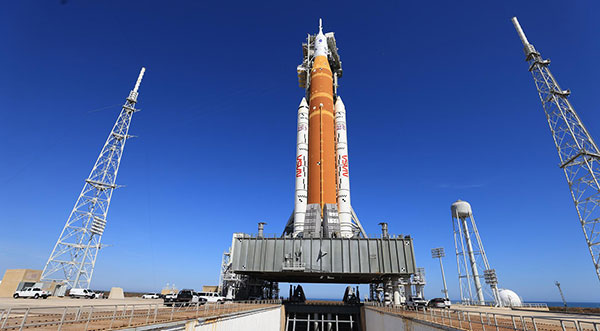
NASA is preparing to potentially roll back the Artemis II rocket and its Orion spacecraft to the Vehicle Assembly Building (VAB) at Kennedy Space Center in Florida. This decision follows an incident on February 21, 2024, where a disruption in the flow of helium to the Space Launch System (SLS) rocket’s interim cryogenic propulsion stage was observed.
Teams at NASA are currently analyzing data to understand the cause of the interruption. They are also making necessary preparations to facilitate the rollback while ensuring troubleshooting options are available at both Launch Pad B and the VAB. The removal of access platforms that were installed recently is underway, as these platforms cannot be dismantled during high winds, which are forecasted for tomorrow.
The SLS upper stage relies on helium to maintain optimal environmental conditions for its engines and to pressurize the liquid hydrogen and liquid oxygen propellant tanks. Although systems functioned correctly during the Artemis II wet dress rehearsals, the teams faced challenges in achieving proper helium flow during subsequent normal operations. These reconfigurations followed the successful completion of the wet dress rehearsal on February 19, 2024.
Challenges in Propellant Management
NASA’s operators have reverted to a backup method to sustain the necessary environmental conditions for the upper stage engines while the rocket remains in a safe configuration. As teams investigate potential issues, they are examining various components, including the interface between ground and rocket lines, a valve in the upper stage, and a filter located between the two systems. Data from the previous Artemis I mission, where troubleshooting of helium-related pressurization also occurred, is being reviewed for insights.
Should the rollback proceed, the launch of Artemis II would not occur within the anticipated March launch window. However, NASA is working swiftly to ensure that the April launch window remains viable, depending on the outcomes of their data analysis, any necessary repairs, and the evolving schedule in the coming days and weeks.
The Artemis II mission represents a significant step in NASA’s efforts to return humans to deep space, involving a crew of four astronauts. The team includes NASA astronauts Reid Wiseman, Victor Glover, and Christina Koch, along with Jeremy Hansen from the Canadian Space Agency. As the situation develops, NASA continues to prioritize safety and thorough investigation to ensure mission success in its future endeavors.

Funko’s Price Target Increased to $4.00 as Analysts React

Humboldt Celebrates as ‘One Battle After Another’ Claims Best Picture

GSK Faces Backlash Over Asthma Inhaler Scrapping, Children Suffer

Adorable Sandhill Crane Colt Hugs Mom in The Villages

USA Unveils Star-Spangled Jerseys Ahead of March Friendlies

Newport Plans Colorful Lighting for Fourth Street Bridge

Sandia Scientists Honored for Innovative Career Journeys

Urgent: Charles M. Payment Passes Away at 78, Memorial Details Inside

NFL Free Agency: Key Moves and Player Signings in Week One

Researchers Launch $1.25M Project for Real-Time Hazard Monitoring in Hawaiʻi

Send It South Revives Culture and Community at The Momentary

UK Government Borrowing Hits £20.2 Billion in September Surge

Flipkart Republic Day Sale: iPhone 16 Plus Price Slashed by ₹23,900

Adecco SA Secures Mixed Ratings from Analysts Amid Earnings Update

Researchers Achieve Record 15.1 mA/cm² Hydrogen Production Efficiency

Globant Reveals Key Tech Forces Shaping Business in 2026

Inventor Achieves Breakthrough with 2 Billion FPS Laser Video

Dua Lipa Aces GCSE Spanish, Sparks Super Bowl Buzz with Fans
-
 Science8 months ago
Researchers Launch $1.25M Project for Real-Time Hazard Monitoring in Hawaiʻi
-
 Entertainment7 months ago
Send It South Revives Culture and Community at The Momentary
-
 World9 months ago
UK Government Borrowing Hits £20.2 Billion in September Surge
-
 Business6 months ago
Flipkart Republic Day Sale: iPhone 16 Plus Price Slashed by ₹23,900
-
 Sports7 months ago
Adecco SA Secures Mixed Ratings from Analysts Amid Earnings Update
-
 Top Stories5 months ago
Researchers Achieve Record 15.1 mA/cm² Hydrogen Production Efficiency
-
 Business8 months ago
Globant Reveals Key Tech Forces Shaping Business in 2026
-
 Science9 months ago
Inventor Achieves Breakthrough with 2 Billion FPS Laser Video
-
 Entertainment10 months ago
Dua Lipa Aces GCSE Spanish, Sparks Super Bowl Buzz with Fans
-

 Top Stories10 months ago
Charlie Sheen’s New Romance: ‘Glowing’ with Younger Partner
-

 Top Stories7 months ago
JSerra Names Hardy Nickerson as First Black Football Coach
-

 Health10 months ago
Community Unites for 7th Annual Into the Light Walk for Mental Health